

Lightweight OpenGL 4.6 shaders for Minecraft 1.16.5–26.2 with volumetric godrays, HDR rendering, 3D clouds, and LabPBR support.
Товар
Про товар
🌌 AuraLite Shaders (Minecraft 1.16 – 26.2)

AuraLite is a modern, lightweight, and highly optimized shader pack built on top of the OpenGL 4.6 / GLSL 460 standard. It is specifically designed and tested for Minecraft 1.16 – 26.2 with Sodium + Iris (and compatible with OptiFine, Oculus).
AuraLite delivers a breathtaking, realistic visual experience without overcomplicating the screen with bloated post-processing effects (such as aggressive motion blur or heavy bloom). A lightweight HDR bloom (gaussian pyramid since v1.1.3, half-resolution and skippable since v1.1.4) softly glows emissive sources without smearing the scene. Optional FXAA/SMAA anti-aliasing, SSR, TAA, godrays, and SSAO are profile-scaled so AuraLite keeps high FPS and smooth frametimes on modern GPUs.
🧪 v1.1.4 note: Adds tiny physical-atmosphere LUTs (
begin/begin1→ 64×32colortex5+ 32×16colortex6), a hard Distant Horizons seam (the v1.1.3 screen-door dither punched white holes on DH 3.2), DH-aware TAA with a material reactive mask, a Gerstner water spectrum, half-res schedulable bloom, and an Iris 1.7.6 compatibility workaround (dhShadow.enabled=falseby default). TAA remains on by default in HIGH/ULTRA/EXTREME; camera jitter stays OFF. See changelog below.
ℹ️ Historical note: older changelog sections below are preserved as original release notes.
🚀 What's New in v1.1.4 — Atmosphere LUTs, Distant Horizons Seam Fix & Half-Res Bloom
Version 1.1.4 rebuilds the experimental physical sky around shared low-frequency LUTs, replaces the hole-producing DH screen-door seam with a deterministic hand-off, and cuts post-process cost with skippable half-resolution bloom. It also finishes the TAA story for Distant Horizons (correct DH reprojection + Halton jitter on LOD geometry) and swaps glittery water fBm for a coherent Gerstner swell.
🧪 Shared Physical-Atmosphere LUTs (begin / begin1)
- Tiny HDR LUTs, not fullscreen buffers. v1.1.3 deleted unused full-screen
colortex5/colortex6to save VRAM. v1.1.4 brings them back as 64×32 solar-transmittance (colortex5) and 32×16 multi-scatter / ground-bounce (colortex6) tables — kilobytes, not megabytes. begin.fshrebuilds direct solar transmittance every frame: sun elevation on X (−0.16…1.0, including civil twilight), camera altitude on Y (0–30 km), Kasten–Young airmass × Rayleigh + aerosol extinction, zeroed below the night hemisphere.begin1.fshlayers bounded multi-scattering and biome-aware ground bounce on top of that transmittance. Noon is Rayleigh-blue; low sun is warm; swamp/snow/vegetation tints come fromGROUND_BOUNCE_MODE.- Shared by every physical-sky consumer —
gbuffers_skybasic, terrain fog, water analytic reflection, volumetric godrays, clouds and the SSR sky fallback all sample the same LUTs instead of each running a second atmosphere march. - When
SKY_MODE=0(every shipped profile) the LUT passes write constants and cost almost nothing. Enable Physical Sky manually in the Experimental tab.
New Experimental → Atmosphere options (off-profile defaults stay cinematic / auto):
ATMOSPHERE_TURBIDITY— Crisp / Balanced / Hazy aerosol load.ATMOSPHERE_SCALE— Compact 25 m / Balanced 50 m / Cinematic 100 m per block (how Minecraft Y maps into atmosphere kilometres).GROUND_BOUNCE_MODE— Auto (biome-aware) / Neutral Soil / Vegetation / Snow / Desert.SKY_TEMPORAL— rotation-only history blend for the sky (requires TAA). Physical sky uses a higher history weight than the animated gradient sky so stars/aurora do not trail.
The swamp detector now also matches BIOME_MANGROVE_SWAMP.
🌍 Distant Horizons — Hard Seam, TAA & Iris Workaround
⚠️ AuraLite still does NOT claim full Distant Horizons compatibility. v1.1.4 is a targeted correctness pass on the v1.1.2/v1.1.3 experimental path.
- Hard deterministic hand-off at
far. The v1.1.3 16 m screen-door dither discarded random LOD fragments in the seam band; on DH 3.2 those holes showed sky/white whenever vanilla geometry did not fill the same pixel. DH fragments withdist < farare now simply discarded — less cinematic, never stochastic. - DH receives the same optional Halton camera jitter as vanilla gbuffers.
composite1.fshreprojects DH pixels throughdhProjectionInverse+dhPreviousProjection(vanilla matrices have the wrong far plane). - Conservative DH history cap (0.45) — LOD meshes change topology as chunks stream; they participate in TAA but cannot leave long trails.
DH_BLOCK_ILLUMINATEDtagcolortex2.a = 0.24— distant sea lanterns / glowstone stay self-emissive even when they are not lava-orange or portal-violet. Extra DH material classes: DIRT, SAND, TERRACOTTA.dh_waternow honoursWATER_WAVES/ riffles / transparency / specular, applies the frozen-ocean navy floor, and occludes againstdhDepthTex1(plus Irisdepthtex1via view-space Z, because raw depths use different projections).DH_SHADOW_RANGE— Seam (1.25×) / Extended (2×) / Far (4×) of vanillafar. LOD receivers can keep sampling the shared shadow map past the vanilla chunk edge.- Shadow-map footprint rebalanced for DH: MED 192 m, HIGH/ULTRA 512 m, EXTREME 768 m (VERY_LOW/LOW stay 60 m, no shadows).
dhShadow.enabled=falseby default. DH 3.2.0-b + Iris 1.7.6 can replace/cull the vanilla terrain shadow pass — symptom: mob shadows remain, block shadows vanish even in vanilla chunks. Users with a verified working Iris/DH bridge can turn the DH shadow pass back on and then useDH_SHADOW_RANGE.
🎯 TAA — Sky Temporal Resolve & Material Reactive Mask
- Sky temporal resolve (
SKY_TEMPORAL) — sky pixels have no stable world position, so history is reprojected with camera rotation only (no translation). Gradient-sky history weight is lower (0.28) than Physical (0.46) so clouds/aurora/meteors do not smear. - Material reactive mask — water (
0.8), foliage (0.62) and emissive/lava (< 0.5) cut history weight by 46% / 30% / 58%. Without a per-object velocity buffer this is what stops waving leaves and water from ghosting after TAA.
🌊 Gerstner Water Spectrum
- Replaces the v1.1.3 value-noise / fBm central-difference normal in
final.fsh. That field was mathematically stable but read as high-frequency random glitter. - A 4-direction travelling swell (dominant wind + cross swell + two low-amplitude ripples) produces analytic slopes and a calmer default surface. Amplitude is clamped to
±0.22. - Near-water vertex swell is slightly reduced (
0.04/0.02 → 0.032/0.016) so the geometric mesh matches the new reflection spectrum. - Dead Voronoi lava-height helpers removed from
gbuffers_water,gbuffers_terrain_translucentandgbuffers_terrain(lava stays texture-driven).
✨ Half-Resolution, Skippable HDR Bloom
- New master
BLOOMtoggle. VERY_LOW / LOW skip the entire 5-pass chain viaprogram.composite3–7.enabled=BLOOM(Iris/OptiFine do not even dispatch the programs). colortex3/colortex4are half-resolution (size.buffer = 0.5 0.5). Gaussian strides are doubled so the world-space radius stays the same;final.fshlinearly upsamples the glow.TAAsimilarly gatescomposite1/composite2, so lighter profiles no longer pay for unused fullscreen passes.
🌌 Aurora Quality
- New
AURORA_QUALITY— Soft 8 / Balanced 12 / Silky 18 raymarch steps, with a centred globally-animated ray start (the previous per-pixel hash grain is gone).
🎚️ Profile Rebalance (v1.1.4)
| Profile | Shadows | DH receivers | TAA | Bloom | Sky temporal |
|---|---|---|---|---|---|
| VERY_LOW / LOW | ❌ 512 / 60 m | Seam | ❌ | ❌ | ❌ |
| MED | ✅ 1024 / 192 m Balanced | Seam | ❌ | ✅ Balanced | ❌ |
| HIGH | ✅ 2048 / 512 m Balanced | Extended | ✅ | ✅ Balanced | ✅ |
| ULTRA | ✅ 4096 / 512 m Aggressive | Extended | ✅ | ✅ Balanced | ✅ |
| EXTREME | ✅ 8192 / 768 m Aggressive | Far | ✅ | ✅ Strong | ✅ |
Camera jitter remains off by default in every profile.
🚀 What's New in v1.1.3 — True TAA, HDR Bloom Pyramid & Black-Water Regression Fix
Version 1.1.3 completes the TAA pipeline (Halton sub-pixel camera jitter + YCoCg variance clipping), replaces the old single-pass bloom with a true multi-octave HDR gaussian pyramid, and fixes the long-standing black-water regression with MRT-proof water detection. It also adds procedural raindrop rings, biome-aware murky swamp water, underwater plant sway, post-TAA sharpening, and a ~48 MB VRAM cleanup.
🎯 True Temporal Anti-Aliasing (Halton Jitter + YCoCg Clipping)
- Halton(2,3) sub-pixel camera jitter — every gbuffer vertex shader can offset
gl_Positionby a rotating 8-frame Halton pattern (±0.5 px). Previously TAA only blended history without jittering the sample point, so it could only blur noise instead of reconstructing sub-pixel detail. TAA_JITTERoption — Off / Subtle / Standard / Strong (new in v1.1.3). The jitter is OFF by default in all profiles for a rock-steady image; Subtle (±0.25 px), Standard (±0.5 px) and Strong (±0.75 px) scale the amplitude for users who want the full sub-pixel reconstruction (removes high-frequency shimmer at the cost of a slight temporal wobble). Requires TAA enabled.- Previous-frame jitter compensation in
composite1.fsh— the old frame's offset is re-added to the reprojection (with the same strength scale), so static images converge instead of smearing ~0.5 px. Only active while jitter is on. - YCoCg variance clipping (μ ± γσ) replaces the axis-aligned 3×3 min/max box — the old box caused ghost trails on saturated high-contrast edges (fences, wires, hot specular) while being too tight on flat gradients. Clip width scales with
TAA_STRENGTH: 1.50 Light / 1.25 Balanced / 1.10 Stable. - Frame-rotated IGN dithers now resolve cleanly — godrays and volumetric clouds rotate their interleaved-gradient-noise patterns per frame; with the temporal resolve they integrate into smooth gradients instead of shimmering.
- TAA is on by default in HIGH / ULTRA / EXTREME profiles (off on VERY_LOW / LOW / MED for maximum FPS); it can be toggled in the Post-Processing menu, and
TAA_STRENGTHpresets the variance-clip tightness.
✨ HDR Gaussian-Pyramid Bloom (composite3 – composite7)
- Replaces the v1.0.1 single-pass 3×3 neighbour glow, whose ~1.5 px radius could only produce a tight halo.
- New 5-pass chain: threshold brightpass (0.75 luma soft-knee, exposure-aware) → tight separable gaussian (9-tap, σ≈2.0) → wide separable gaussian (4× stride). Successive blurs compose to an effective σ ≈ 8.2 px — a soft cinematic falloff around the sun/moon disks, lava, portals and hot specular, without a mip chain.
- Runs after the TAA resolve, so the bloom energy is temporally stable.
- New
HDR_BLOOMoption (Subtle 0.06 / Balanced 0.12 / Strong 0.22 amplitude) wired into every quality profile.
💧 Black-Water Regression Fix — MRT-Proof Water Detection
- Root cause: on some Iris builds the translucent pass drops the
colortex1/colortex2MRT writes entirely — water then arrives with a zeroed normal + alpha + lightmap. The emissive fast-path (alpha < 0.5) swallowed it and every tag/lightmap-based system died with it. - Detection ladder: primary =
colortex2.a = 0.8tag; rescue = the depth difference (depthtex1solid-only vsdepthtex0) proves a translucent surface on top, then a hue-fingerprint classifier on the albedo rejects portals (violet, green-starved) and lava (blue-starved) while accepting water (blue/blue-green, never pale). Water, ice and glass classify; torch flames, portal sparkles, squid ink, pale ice and clear glass do not. - Synthesized flat water normal when the decoded normal is untrustworthy (MRT loss or clear value), so Fresnel/reflections still have sane inputs.
- Analytic sky reflection (
waterSkyRefl) — zenith/horizon gradient + warm sun-side glow, dimension-aware (Overworld palette, Nether biome sheen, End violet sheen), applied via Schlick Fresnel with a 0.20 floor (pure F0≈0.02 at steep look-down angles was exactly what let shadowed water crush to black), multiplied by skyLight so cave water stays dark. This is the actual black-water fix and works with SSR disabled. - Diffuse ambient floor for rescued pixels whose lightmap may read zero.
- Navy-tint floor in
gbuffers_water/gbuffers_terrain_translucent— frozen-ocean biome tints (e.g. 0x3938C9) can no longer crush R/G to black after the gamma pipeline. WATER_DEBUGdiagnostics overlay (Off / Classify / Lightmap / Raw tag alpha) — green = healthy tag, red = depth-rescued, yellow = rescued from the emissive path, magenta = lava/portal-guarded.
🪟 SSR & Refraction Fixes (final.fsh)
- Procedural sky fallback for reflection rays that leave the screen or hit the sky — previously black (the reason the
waterMirrorBoosthack existed); now a day/night/sunset/storm-aware gradient with moon-phase brightness, Schlick-Fresnel weighting and edge fade. - SSR march start moved 1.0 → 0.5 view units off the surface so the water plane at the player's feet still reflects near-field geometry.
- MRT-proof water detection reused for SSR/refraction (same hue guards as
composite.fsh). - Procedural raindrop rings on wet up-facing surfaces — two layers of expanding, world-stable circular waves perturb the SSR normal so rain reads as thousands of tiny ripples instead of one flat mirror.
🔍 Post-TAA Sharpening (POST_SHARPEN)
- Gentle 5-tap unsharp mask (0.18 amplitude, clamped ≥ 0) applied to the resolved image before refraction/SSR/bloom work, recovering texture detail softened by TAA's history blending. On in MED+ profiles.
☁️ Volumetric Clouds — Quality Scaling & Dithered Ray Start
- New
CLOUD_QUALITYoption: 8 / 12 / 16 raymarch steps (was hardcoded 12) — Cheap / Standard / High. - Dithered ray start (frame-rotated IGN) on geometry pixels when TAA is enabled: the frame-rotating pattern is temporally resolved into a smooth volumetric integral, killing the 12-step ribbing on thick cumulus without the v0.2.5-era "swimming". Sky pixels keep the stable centred start.
🌿 Underwater Plants Sway
- New block class 10010 (
seagrass,tall_seagrass,kelp,kelp_plant,sea_pickle) — fronds sway in a current, phase-shifted by height so the tips lag the base, storm-agitated along with the surface foliage path. Displacement is mirrored inshadow.vshso shadows follow the visible fronds.
🌊 Biome-Aware Murky Water
- Smoothed swamp/mangrove detector (
isSwampBiome) — swamp water absorbs more red and reads greener and murkier (absorption (0.23, 0.038, 0.10), deep colour pushed to dark green) instead of open-ocean blue.
🧪 Physical Sky — Warm Ground Bounce
- The experimental
SKY_MODE=1atmosphere now includes a warm ground-bounce term: terrain's ~15–20% mean albedo re-scatters in the lower atmosphere (strongest at the horizon and with a high sun), removing the "sterile" blue-bias horizon band.
🌇 Lighting & Ambience
- Rayleigh-tinted day ambient — the day hemisphere ambient now follows the actual sun extinction: golden-hour light is warm and blue-depleted instead of static grey-blue.
- Held-light temperature — strong held sources (sea lantern, glowstone, shroomlight, lava bucket) read slightly cooler than candle-strength light.
🌍 Distant Horizons — Soft Seam
- The v1.1.2 hard
discardatfar + 16is replaced by a screen-door dithered transition band: DH LOD fragments stochastically blend into vanilla chunks over 16 m, so crossing the boundary or changing render distance no longer shows a hard cut. The pattern is static per frame (DH-only pixels are excluded from TAA history).
🛠️ Pipeline & VRAM Cleanup
- Removed
colortex5/colortex6format directives — never read or written, but each forced Iris/OptiFine to allocate a full RGBA16F screen buffer: ~32 MB saved @1080p, ~128 MB @4K. shadowcolor0FormatRGBA16F → RGBA8 (it only carries LDRtex * glcolor): another ~16 MB @1080p / ~64 MB @4K.shadowcolor1Formatremoved (nothing ever wrote to it).colortex0Clear = true— no stale garbage on the first frame or after a window resize.colortex3/colortex4are now actually used by the bloom pyramid; the full 8-buffer HDR pipeline is engaged.
🚀 What's New in v1.1.2 — Render-Distance Shadows & Experimental Distant Horizons (Partial)
Version 1.1.2 extends shadow rendering to the actual render distance with an adaptive LOD system, fixes HDR/TAA pipeline strictness, cleans up deprecated GLSL, and introduces partial, experimental Distant Horizons support (WIP) — without claiming full compatibility yet. Work is ongoing.
🌗 Extended Shadow Distance with Adaptive LOD
- Shadows now reach render distance.
shadowDistancewas60-160mwith a hard cutoff atshadowDistance. Now it scales with quality profiles: 60m (VERY_LOW/LOW, no shadows) → 120m (MED) → 256m (HIGH/ULTRA) → 384m (EXTREME). The cutoff is replaced by a soft fadesmoothstep(far*0.85, far*0.98). - New
SHADOW_LODtoggle — Off / Balanced / Aggressive. Reduces sample count and expands filter radius at distance to keep performance stable: - Balanced:
>25% far → 16 samples ×1.8 radius, >50% → 8 ×2.8 - Aggressive:
>15% → 16×2.0, >35% → 8×3.5, >60% → 4×5.0 - Beyond 95%
farshadow sampling is skipped entirely. shadowMapResolutionnow includes8192. EXTREME uses 8192 for maximum texel density at 384m. HIGH stays 2048, ULTRA 4096.- New
SHADOW_PCSS_BLURtoggle — fixed softness vs PCSS penumbra softening. When enabled, penumbra grows with blocker distance and rain. When disabled, shadows use constant softness. - PCSS correctness fixes in
composite.fsh:sampleShadow(): added UV bounds checks (prevents clamp-to-border artifacts),avgBlockerDepthclamped to1e-4to avoid NaN,penumbraSizeclamped0-2.0,lightSizereduced140→40to prevent light bleeding,actualSpreadcapped to16.0, out-of-bounds samples counted as unshadowed (1.0) for correct averaging. - Shadow bias
distBiasnow scales withfarinstead ofshadowDistance, plus extra water receiver bias for tagged water pixels (colortex2.a≈0.8).
🔧 HDR Pipeline Strictness Fix
- Dummy
#define RGBA16F 0guards added before theconst int colortex*Format = RGBA16Fdirectives. This satisfies strict GLSL validators (C1503 undefined variable RGBA16F) while Iris/OptiFine's parser still reads the format names (spec second clause). In v1.1.1 the directives were inside a/* */comment and were ignored by some loaders. - Now all used buffers are explicitly
RGBA16F:colortex0/1/2(main HDR + PBR + material tags),colortex3/4/5/6(unused today but set to HDR for a full pipeline),colortex7(TAA history,colortex7Clear=false), and optionalshadowcolor0/1Format = RGBA16F. - Cost noted: ~16MB per 1080p RGBA16F buffer → ~128MB VRAM for 8 buffers.
🌍 Experimental — Partial Distant Horizons Support (WIP, not full support)
⚠️ AuraLite does NOT yet claim full Distant Horizons compatibility. v1.1.2 only adds a minimal, experimental code path so LOD chunks are no longer invisible under Iris. It's functional enough for testing, but considered partial and work-in-progress.
- Why it was needed: Without
dh_terrain.vsh/.fsh,dh_water.vsh/.fsh,dh_shadow.vsh/.fsh, Iris marks the pack as incompatible with DH and simply doesn't draw DH's simplified LOD chunks at all — symptom "shader works but DH chunks invisible". Presence of these files is enough for Iris/DH auto-detection (dhShadow.enableddefaults true). - What v1.1.2 does:
dh_terrain/dh_waterwrite the samecolortex0/1/2layout as vanilla passes, so existing lighting/fog/shadow/cloud/godray code incomposite.fshapplies to LOD geometry without other changes.- Depth reconciliation in
composite.fsh: detectsdepthtex0>=1.0 && dhDepthTex0<1.0→isDHTerrain, reconstructs viewPos viadhProjectionInverse(notgbufferProjectionInverse— different far planes) and computesisSkyPixel. Fixes DH terrain being treated as sky (flat/washed-out). - Fog rescale:
effectiveDensity *= far/dhRenderDistanceprevents exponential fog from saturating to white before DH draw distance. - Emissive fast-path uses
!isSkyPixelinstead ofdepth<1.0so distantDH_BLOCK_ILLUMINATED(glowstone/lanterns) is still emissive. final.fshheat shimmer now checksdhDepthTex0viaisRealGeometryso distant lava lakes also shimmer.- Overdraw prevention:
if(dist < far+16.0) discardin DH passes — DH renders entire world including area already covered by vanilla chunks; without discard both fight over same G-buffer pixel causing Z-fighting / missing water/ice. - Current limitations (why it's partial):
gl_MultiTexCoord2is not guaranteed to carry valid lightmap data for DH programs — v1.1.2 hardcodeslmcoord = vec2(0.0,1.0)(open sky, no torch). Correct for exterior DH, but not interior-perfect.- No LabPBR
normals/specularmaps for DH — roughness/metalness approximated perdhMaterialId(STONE/WOOD/METAL/SNOW/LEAVES/LAVA...). No POM on DH. - Water uses flat vertex normal, not procedurally displaced like near water.
- Fog/sky/cloud code paths are shared but DH has coarser geometry.
- Ongoing work: proper skylight baking if DH ever exposes it, LabPBR fallback, smoother transition seam, performance tuning. Full support will be announced separately.
🛠️ Pipeline Cleanup & Fixes
- Menu split fix —
[v1.1.1-ui-hotfix]: Oversized option screens were split into[SHADOW_OPTIONS],[PBR_OPTIONS],[AO_REFLECTIONS],[CLOUD_SHAPE],[LIGHT_SHAFTS],[NIGHT_SKY]because some Iris/OptiFine UI builds silently hide buttons when a screen has too many entries. - Deprecated
ftransform()removed fromcomposite.vsh,final.vsh,gbuffers_clouds.vsh,composite1.vsh,composite2.vsh,gbuffers_weather.vsh— replaced with explicitgl_ProjectionMatrix * gl_ModelViewMatrix * gl_Vertexfor broader driver compat (same fix applied toshadow.vshin v1.1.0). - Final pass cleanup: Removed two duplicate copy-pasted post-gamma dither blocks that contradicted the comment about linear-space dither (triangle
±1/255before tonemap). The single pre-tonemap dither remains — more effective in darks, silent in brights. - Bias & stale comment fixes: Corrected stale
colortex6hand-off comment (removed in v1.0.3), now notes thatfinal.fshreads normal fromcolortex2and roughness fromcolortex1.z. - Rebalanced profiles to reflect new distances and LOD:
- VERY_LOW/LOW 60m (no shadows), MED 120m Balanced, HIGH 256m Balanced, ULTRA 256m Aggressive, EXTREME 384m Aggressive + 8192 res.
- Localization: Bumped
lang/*.langheadersv1.0.7 → v1.1.2, translated previously-Englishprofile.*.commentplaceholders into native languages (ur_pk, vi_vn, zh_cn, zh_hk, zh_tw and others).
🆕 What's New in v1.1.0 — True Volumetric Godrays, HDR Pipeline & Experimental Physical Sky
Version 1.1.0 replaces the screen-space godray approximation with a fully volumetric raymarched implementation, switches the entire G-buffer pipeline to true HDR (RGBA16F), and introduces an experimental, fully physical realtime atmospheric-scattering sky mode as an opt-in alternative to the stable gradient sky. This is a focused two-pillar update on top of the v1.0.7 bug-fix baseline.
🌤️ True Volumetric Godrays
The old computeGodrays() screen-space approximation has been replaced by computeVolumetricGodrays() — a genuine single-scattering volumetric raymarch:
- Per-step shadow-map occlusion — every raymarch sample now tests the shadow map individually, so light shafts are actually carved by real geometry (trees, buildings, cave ceilings) instead of being implied by a "forward-looking boost" toward the sun.
- Interleaved Gradient Noise dithering (Jimenez 2014), rotated per-frame via the new
frameCounteruniform when TAA is active — 8–24 raymarch steps now integrate as smoothly as hundreds, with no banding. - Exact per-segment Beer–Lambert integration —
Tr₀ · σs/σt · (1 − e^(−σt·Δx))per step, which is energy-conserving regardless of step size (no more over-brightening at low sample counts). - Dual-lobe Henyey-Greenstein phase function (forward + weak backscatter lobe) with an isotropic floor, so crepuscular rays stay visible when looking across them, not only when staring directly at the sun.
- Colored radiance — shafts are now warm Kelvin-driven sunbeams by day, deep orange at sunset, and faint blue moonbeams at night, instead of a flat white/yellow overlay.
- New
GODRAYS_STRENGTHsetting (Subtle / Balanced / Dramatic) added to every quality profile. GODRAYS_QUALITYsample counts and distances increased: Fast 8 samples/96m, Balanced 16/128m, High 24/160m (up from 4/72m, 6/110m, 8/150m in v1.0.7).
🌈 Full HDR G-Buffer Pipeline
colortex0,colortex1, andcolortex2are now explicitlyRGBA16F. Bright sources — the sun disk, lava, specular highlights, portals — no longer clip to1.0before tone mapping, so the ACES/AgX curves infinal.fshfinally compress genuine HDR highlights instead of receiving pre-clamped input. Bloom now samples real HDR luminance rather than an already-saturated LDR buffer.colortex2's alpha channel carries a 5-value material tag (0.0/0.1/0.62/0.8/1.0); RGBA16F guarantees these are preserved exactly, whereas a lower-precision format would have aliased and collided material tags (e.g. foliage vs. water).- Godray intensity constants were re-tuned (roughly halved vs. the old LDR values) now that the additive shaft survives in full instead of clipping against a saturated scene; a stronger soft shoulder (
0.50vs. the old0.30) keeps the sun-facing core from blowing out under HDR.
🧪 Experimental: Realtime Physical Sky (Off by Default)
A brand-new [EXPERIMENTAL] menu tab exposes an alternate sky renderer in gbuffers_skybasic.fsh, disabled in every shipped profile (SKY_MODE=0) so the stable gradient sky remains the default:
SKY_MODE—0(Gradient, legacy v1.0.7-style sky) or1(Physical Realtime): a genuine per-pixel ray-marched atmosphere with exact 1st-order single scattering (Rayleigh + Mie + Ozone, full sun-ray optical-depth march with ground-occlusion detection) plus a blue-biased, bounded multiple-scattering ambient term that fills in the zenith/horizon without producing the typical LUT-based "yellow band" artifact. No lookup textures, no cross-frame reads.SKY_QUALITY— controls raymarch sample counts (Fast 8×4 / Standard 12×6 / High 16×8) for the physical mode.SKY_STYLE— new artistic-direction toggle independent ofSKY_MODE: Realistic (true angular sun/moon size, neutral colors, minimal glow — an authentic astronomy look), Semi-realistic (readable ×2.8 sun/moon size, richer color, soft aureole — the default), or Fantasy (grand ×5.5 sun/moon, huge corona, vivid saturated teal/crimson/indigo palette for a stylized sky).- Physical mode renders the sun disk with real limb darkening and a physically-derived angular radius, and computes its color from actual sun-ray transmittance (ozone-aware) rather than the legacy Kelvin/airmass approximation.
- Because this feature is explicitly experimental and disabled by default, it introduces no behavioral change to any existing profile.
🛠️ Smaller Fixes & Cleanup
- Dark-sky/moon-halo banding fixed at the source — a linear-space triangle-distributed dither (
±1/255, matching the BSL/Complementary technique) is now applied infinal.fshbefore tone mapping, where gamma expansion makes a tiny linear noise term large enough in the darks to smooth the gradient, while staying invisible in bright regions. The old post-gamma dither (which couldn't fix pre-tonemap banding) has been removed and replaced with an explicit finalclamp(). shadow.vshno longer relies on the deprecated fixed-functionftransform(); it now builds the clip-space position explicitly viagl_ModelViewMatrix/gl_ProjectionMatrixfor broader driver compatibility.- Updated localization strings for
GODRAYS,GODRAYS_QUALITY, and the newGODRAYS_STRENGTH/SKY_MODE/SKY_STYLE/SKY_QUALITYoptions and the new Experimental tab.
🆕 What's New in v1.0.0 — Meteor Showers & Finalized Reflection Pipeline
Version 1.0.0 builds on the volumetric aurora work from v0.3.0 and introduces the first v1.0.0 source snapshot in this repository. The update adds a physically-inspired meteor system to the night sky, finalizes the modern SSR path for reliable Iris compatibility, and refreshes the documentation so the project now correctly points to the shaders v1.0.0/ folder.
☄️ Physically-Based Meteors / Falling Stars
- True great-circle sky arcs. Meteors are rendered as moving arcs on the celestial sphere instead of flat 2D streaks, so showers converge toward a shared radiant like real meteor photography.
- Ablation-based brightness curve. Each meteor rises, peaks, and fades with a bell-shaped light curve inspired by atmospheric entry.
- Blackbody plasma colouring. Meteor heads are tinted with the same Kelvin-based colour pipeline used by AuraLite's sun/moon lighting, giving physically consistent warm-to-white fireball tones.
- Moonlight washout and weather attenuation. Faint meteors are suppressed by bright moon phases, rain, and daytime sky brightness, improving realism and avoiding visual clutter in poor visibility.
- Persistent trains on bright fireballs. The strongest events leave a short-lived glowing ionization trail, including a subtle green oxygen-style tint on the lingering train.
- Available in both Overworld and The End. Overworld meteors respect moonlight and atmosphere; End meteors render against the permanent night sky without moon washout.
🪞 Finalized v1.0.0 SSR / Water Reflection Path
colortex6fully removed from the reflection workflow. The older MRT export path was retired;final.fshnow reads normals directly fromcolortex2and roughness fromcolortex1, matching AuraLite's already-working PBR data path.- Depth-based water-surface detection. Water is identified by comparing
depthtex0anddepthtex1, making reflections robust on Iris paths where water G-buffer writes may be inconsistent. - More stable water normals. Reflection normals are reconstructed from neighbouring depth samples and then perturbed with coherent world-space ripple gradients, reducing faceting and torn reflections.
- Cleaner post-pass reliability. The reflection pipeline now lives entirely in the final post-processing pass, simplifying the frame graph and avoiding loader-specific MRT issues.
🎛️ New Sky Settings & Profile Integration
- New configurable options:
SHOOTING_STARS,SHOOTING_STARS_FREQUENCY, andSHOOTING_STARS_BRIGHTNESS. - Shooting stars are disabled on the lightest presets and enabled from MED upward through the normal profile system.
- English and Russian UI text was expanded for the new night-sky controls, while other language files continue to fall back safely.
🆕 Recap — What landed in v0.2.6 — License Migration & Version Support
Version 0.2.6 is a legal protection and compatibility update. It migrates the project license to a copyleft non-commercial model to protect AuraLite from unauthorized commercial redistribution, adds copyright assertions to all source files, and officially expands tested compatibility.
⚖️ License Migration to CC BY-NC-SA 4.0
- MIT to CC BY-NC-SA 4.0 — Migrated the project's license from MIT to Creative Commons Attribution-NonCommercial-ShareAlike 4.0 International. AuraLite is now legally protected against commercial reuse and unauthorized sales (e.g. on third-party launchers/portals).
- Copyright Asserted — Explicitly declared copyright:
Copyright (c) 2026 AlexanderNyr. - Embedded Code Headers — Embedded copyright headers (
// AuraLite Shaders - Copyright (c) 2026 AlexanderNyr. Licensed under CC BY-NC-SA 4.0.) into all GLSL shader files (.fsh,.vsh), block properties (.properties), and translation tables (.lang). - Rules & Permissions FAQ — Added a clear FAQ section outlining allowed actions (monetized videos/streaming, inclusion in free CurseForge/Modrinth modpacks) and prohibited actions (commercial sales, paid Patreon redistributions, raw rehosting on ad-supported download hubs).
🎮 Version Compatibility Expansion
- Minecraft 26.1.2 Support Verified — Tested and verified to work flawlessly on the latest Minecraft Java hotfix 26.1.2 with Iris + Sodium.
- Minecraft 1.16.5 Support Verified — Tested and confirmed to run beautifully on the legendary modding version 1.16.5 (Iris/OptiFine).
✨ Features At A Glance
☁️ 1. Meteorological 3D Volumetric Clouds (Fly-Through!)
AuraLite features a fully physical, flyable 3D cloud system driven by 12-step Raymarching in world coordinates:
- True 3D Space: Clouds float at a physical height (configurable base altitude). You can fly up, enter a dense, foggy overcast, and rise above the clouds to see an endless rolling sea of fluffy cumulus clouds.
- Camera-Inside-Cloud Veil (v0.2.5): When flying inside the cloud layer, a soft volumetric white/grey fog surrounds the camera.
- Independent Wind-Shear Layers (v0.2.5): Each cloud layer (Cirrus, Altocumulus, Altostratus, Cumulus) moves on its own rotated/sheared domain with the
WIND_SPEEDsetting. - Cloud Render Distance (v0.2.5): New 4-step control (Near / Standard / Far / Very Far) — from 3 000 m to 16 000 m horizon-scale decks.
- Beer's Law Self-Shadowing: Realistic light absorption makes cloud bottoms dense and dark while cloud tops glow with brilliant white/gold illumination.
- Mie Scattering (Silver Lining): Looking towards the sun produces a glowing golden halo around the cloud edges.
- Overcast Storms: When raining (
/weather rain), the fluffy cumulus clouds automatically expand, darken, and merge into an ominous, heavy Nimbostratus/Cumulonimbus storm deck.
🌠 2. Living Night Sky (since v0.2.0)
The night sky is no longer just a static starfield — it's a fully procedural cosmos:
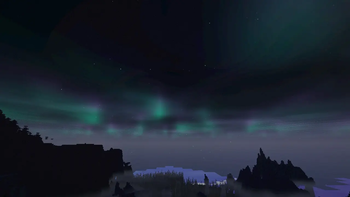
- Aurora Borealis: Realistic, flowing northern lights that ripple across the upper sky. Modes: Disabled / Only in Cold Biomes / Always Enabled, with independent speed and brightness controls. (v0.2.5: rendered in
gbuffers_skybasicfor reliability; cold-biome detection uses real biome uniforms. v1.0.7: tone softened and high-frequency noise removed — read as a photographic glow rather than oversaturated neon.) - Milky Way Nebula: A subtle diagonal brownish galactic band glows softly above the horizon, with adjustable brightness.
- Procedural Stars: Independent brightness and density sliders let you choose between a few crisp pinpricks or a brilliantly dense Hubble-style sky. Stars sparkle and twinkle in real time.
- Physically-Based Meteors / Falling Stars (v1.0.0): configurable meteor activity, brightness, moon washout, and persistent ionization trails bring realistic night-sky streaks to the Overworld and the End.
- Persistent Rainbow: After rain stops, a soft rainbow arcs across the sky and gently fades out as the
wetnessuniform decays. Brightness and saturation are configurable.
☀️ 3. Analytical Kelvin Sun & Moon — Enhanced in v0.2.2, refined in v0.2.5
- Tanner Helland Blackbody Sun: Sunlight color temperature is dynamically calculated in real time based on the sun's elevation angle using a physically-correct blackbody Kelvin curve (selectable: Cool / Realistic / Warm Golden). This yields photoreal sunrise/sunset colors (~1800K–2200K), warm golden hours (~2800K), and clean crisp white noon light (~5700K–5800K).
- Beer-Lambert Atmospheric Extinction: Sunlight intensity dynamically drops as the sun approaches the horizon due to scattering in thick atmospheric masses: $airMass = \frac{1}{\sin(\alpha) + 0.15 \cdot (\alpha_{deg} + 3.885)^{-1.253}}$ This yields incredibly soft, rich, and breathtaking sunset and sunrise golden hour transitions!
- Independent Sun & Moon Intensity (v0.2.2): 4-step master sliders let you push the day brighter (Blazing) or sink nights into total darkness (Pitch Night).
- Moon Color Temperature (v0.2.2): choose between Icy Blue (cold), Silver (physically accurate 4100K), or Warm Cream (harvest-moon).
- Sun Halo (Mie forward-scatter) & Enhanced Sunrise/Sunset Glow (v0.2.2) — warm scattering effects on terrain when looking near the low sun.
- 🆕 Extended Twilight Window (v0.2.5): Sunset/sunrise lighting stays warm/red at
/time set 12800instead of snapping to neutral. - Crispy Circular Sun & Moon Disks: Custom procedural, perfectly round, anti-aliased sun and moon disks are drawn onto the sky dome with glowing coronas and soft halo scattering.
👥 4. Soft Shadows, Immersive Dark Nights & Cozy Lights — Enhanced in v0.2.2, refined in v0.2.5
- Rotated Poisson Disk Soft Shadows (v0.2.2): replaces the old fixed 3×3 PCF kernel. Three quality steps — Sharp / Soft / Ultra Soft — give natural-looking penumbra on shadow maps up to 4096×4096.
- 🆕 Shadow Slope Bias Fix (v0.2.5): bias now uses raw NdotL to prevent acne artifacts.
- Shadow Distance Control (v0.2.2): cap dynamic shadow rendering at 60m / 80m / 120m / 160m for performance or quality tuning.
- Shadow Tint (v0.2.2): realistic cool-blue tint for daytime shadows under an open sky (or neutral / warm if you prefer).
- Ambient Lift (v0.2.2): control how dark shadowed areas appear at night and in caves.
- Light Wrap (Terminator Softness) (v0.2.2): choose physical Lambert, a soft photographic wrap, or a stylized look. (v0.2.5: all profiles default to realistic Lambert.)
- 🆕 SSAO / SAO Contact Ambient Occlusion (v0.2.5): screen-space darkening in corners and at geometry intersections. Enabled on ULTRA+ profiles.
- Deep Dark Nights (2× darker): Night ambient light, moonlight intensity, and fog are reduced by 2× by default to create incredibly atmospheric, immersive nights. Caves and forests are pitch dark, requiring torches for exploration (combine with the new Pitch Night moon preset for extra spice).
- Warm Block Lights: Torches, lanterns, and lava emit a cozy golden-amber glow with physically accurate quadratic falloff.
- 🕯️ Cozy Torch Flickering (since v0.2.0): Real-time flickering animations for torches, campfires, and lanterns add a living, warm atmosphere to your shelters. Held-item light contribution (
heldBlockLightValue) is also accounted for.
🌊 5. Physical Fresnel Water & Silver Moonlight Path — Refined in v0.2.5
- Fresnel Effect: Water reflectivity is mathematically calculated based on your viewing angle. Looking straight down provides crystal transparency, while looking towards the horizon transitions water into a highly reflective, glossy sheet reflecting the sky dome.
- Silver Moonlight Path: Moonlight specular reflection on water ripples has been increased by 4.5×. At midnight, a brilliant silver lunar reflection path shimmers across the waving ocean.
- 🆕 Unified GGX PBR Water Specular (v0.2.5): Water's old Blinn-Phong specular replaced by composite's GGX microfacet model with proper Fresnel — physically consistent with terrain PBR.
- 3D Geometric Waves: Vertex shader waves physically displace the water mesh in real-time, and react to
rainStrength/thunderStrengthfor choppier seas during storms. - Independent Ripple & Specular Controls (since v0.2.0):
WATER_RIFFLES(Calm / Standard / Choppy) andWATER_SPECULAR_STRENGTH(Soft / Standard / Glinting) can be tuned separately for the perfect water mood. - Zero Feedback Glitches: Designed to be extremely stable, utilizing no feedback-loop depth buffer reads to guarantee bug-free solid rendering on all GPUs.
🌧️ 6. Dynamic Weather Surfaces (since v0.2.0)
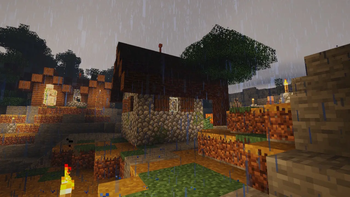
- Wet Reflections: During rain, solid blocks like grass, dirt, and stone darken and become glossy, picking up sky reflections under open weather. Disables itself under roofs.
- Low Ground Mist (Y ≈ 60–70) (refined in v0.2.5): Soft fog sheets drift across water and ice surfaces at dawn and dusk. Uses large slow sheets + small breakup noise with optical distance accumulation for natural-looking radiation fog. Humidity from rain/wetness makes the mist persist longer.
- Camera-Inside-Mist Veil (v0.2.5): Standing inside the mist layer produces a subtle whole-view forward-scattering veil.
- Thunderstorm Awareness: Shaders distinguish between regular rain and full thunderstorms via the
thunderStrengthuniform, intensifying cloud darkness and wave chop accordingly.
🌿 7. Lively Foliage
- Waving animations for oak/spruce/birch leaves, tall grass, flowers, vines, lily pads, and crops.
- Gently animated using hardware-optimized sine waves and time constants.
- 🧊 Ice fix (since v0.2.0, refined in v1.0.4): regular ice renders with texture + semi-transparency; packed/blue ice renders opaque with texture. All ice types have waving and refraction disabled to eliminate visual glitches.
- 🪟 Glass rendering (v1.0.4): all glass blocks and panes (including every stained-glass variant and tinted glass) now render with their actual texture and proper transparency via the dedicated translucent terrain pass.
💎 8. Full LabPBR 1.3 Material Support + POM — PBR refined in v0.2.5
- 3D Normal Maps: Real-time TBN (Tangent-Binormal-Normal) matrices generate true three-dimensional depth on blocks (stone crevices, brick joints) reacting dynamically to light angles.
- Specular Reflection (GGX Microfacet): Polished surfaces give sharp glossy glints, while metallic surfaces (gold, copper, iron) tint the specular reflection with the block's native albedo. (v0.2.5: correct NdotL cosine factor added for Cook-Torrance BRDF accuracy.)
- 🧱 Parallax Occlusion Mapping (POM) (since v0.2.0): True per-pixel block relief that pops out of the surface. Configurable
POM_DEPTH(1–3) andPOM_STEPS(1–4). Disabled in all profiles by default for stability; can be enabled manually. Recommended to keep off on incompatible resource packs. - Seamless Fallback: Falls back automatically to gorgeous flat vanilla textures if no PBR resource pack is active.
🌀 9. Cosmic Nether Portal (since v0.2.0, improved in v0.2.5)
The vanilla Nether portal texture is procedurally transformed into a swirling 3D plasma vortex — animated purple/magenta cosmic energy that pulses with hypnotic depth. Mapped via dedicated block ID 10006 in block.properties. (v0.2.5: portal pixels are flagged as emissive so composite skips scene lighting and displays the plasma as-is.)
🪟 10. Translucent Block Rendering (added in v1.0.4, unchanged in v1.0.6)
AuraLite renders translucent blocks with proper per-block transparency through a dedicated gbuffers_terrain_translucent pass, ensuring correct display on both Iris and Oculus pipelines:
- Regular ice — semi-transparent with actual texture; opacity scales with
WATER_TRANSPARENCY(Clear / Balanced / Deep). - Packed ice / blue ice / frosted ice — opaque with texture, visually distinct from regular ice.
- All glass blocks and panes — every vanilla glass type (clear, all 16 stained variants, pane variants, tinted glass) renders with its actual texture and correct transparency. No more invisible glass against bright skies.
🎬 11. Cinematic Post-Processing — Refined in v1.0.1, v1.0.3
- Multiple Tone Mapping Curves (since v0.2.0): Pick from Soft, Filmic (ACES), or Intense (High Contrast) to match your preferred mood.
- Color Vibrancy (since v0.2.0): 4-step non-linear saturation control (Muted / Balanced / Colorful / Vivid) that makes foliage glow emerald and skies look lush, without crushing skin tones.
- Exposure Brightness: Muted / Balanced / Vibrant — global brightness lift.
- Subtle Vignette: Gentle lens-darkening at screen edges for improved depth and immersion.
🔥 12. Procedural Lava & Heat Shimmer (v1.0.6)
- Procedural Magma Surface: Lava and flowing-lava blocks are rendered with a procedural Voronoi crack field, animated convection flow, rare hot spots, and rising bubbles.
- 3D Parallax Cracks: A 4-step parallax occlusion raymarch gives real depth between the dark basalt crust and glowing magma.
- Viscous Vertex Waves: The top face slowly swells with a heavier, slower wave than water, giving a molten feel.
- Heat Shimmer:
final.fshapplies a subtle screen-space distortion above lava pixels to simulate rising hot air. - PBR-Ready: Rough basalt crust (0.95) and glossy magma cracks (0.02) produce physically plausible highlights.
🛡️ 13. Realistic Atmospheric Fog (v0.2.5)
- Fog density now accounts for altitude (aerosol concentration decays with height), horizon path length, and indoor/outdoor exposure via skylight.
- Consistent Beer-Lambert distance fog with height-weighted density — no delayed fog walls.
☁️ Cloud Altitude Classification
AuraLite's sky is meteorologically modeled after the international cloud classification system:
Altitude (m)
16 000 ─ ─ ─ ─ ─ ─ ─ ─ ─ ─ ─ ─ ─  ↑ Cumulonimbus (Cb)
12 000 ─ ─ ─ ─ ─ ─ ─ ─ ─ ─ ─ ─ ─ ─│
10 000   Ci  ─ Cirrus              │ Vertical
 8 000   Cc  ─ Cirrocumulus         │ Development
 6 000 ─ ─ Cs ─ Cirrostratus ─ ─ ─ ─│─ High Clouds (Cirrus layer)
 5 000   Ac  ─ Altocumulus          │
 4 000   As  ─ Altostratus          │
 2 000 ─ ─ ─ ─ ─ ─ ─ ─ ─ ─ ─ ─ ─ ─│─ Mid Clouds
 1 500   Sc  ─ Stratocumulus        │
 1 000   St  ─ Stratus              │
 500     Ns  ─ Nimbostratus         │─ Low Clouds (Cumulus layer)
   0 ─ ─ Cu ─ Cumulus ─ ─ ─ ─ ─ ─ ─│
AuraLite smoothly transitions these layers based on in-game weather conditions (clearing, rain, or storms).
⚙️ Performance Optimizations (OpenGL 4.6 Native)
AuraLite is built from the ground up for maximum FPS using OpenGL 4.6 native hardware operations:
- Multiply-Add Friendly Math: Wave and waving-foliage math is written as simple multiply-add expressions so modern drivers can optimize it efficiently, while avoiding the explicit
fma()intrinsic that caused compilation issues on some GPUs / Mesa drivers. - Bitwise Noise Generation: Replacing slow transcendental float functions (
fract(sin(dot(...)))) with ultra-fast Integer Bitwise PCG-style hashes utilizingfloatBitsToUintanduintBitsToFloat. - Early-Ray Termination: Volumetric raymarching terminates instantly once cloud transmittance falls below 2%, saving rendering power.
- No Hand Transparency Glitches: Handheld items, particles, and mobs are rendered in a separate stable path without tangent matrix overhead, eliminating "translucent hand" bugs.
- Dead Code Elimination (v0.2.3–v0.2.5): Removed unused noise/fbm functions, dead cloud raymarching code from
gbuffers_skybasic, and redundant render calls to reduce GPU compilation time. - Profile-Based Scaling: Every feature (POM, Auroras, SSAO, Cozy Lights, Wet Reflections, Ground Mist, Shadow Distance, Cloud Distance, Sun Halo, etc.) is intelligently distributed across the LOW / MED / HIGH / ULTRA / EXTREME profiles so low-end systems don't pay for effects they can't afford.
🎛️ In-Game Configuration Options
AuraLite includes localized in-game configuration files for 69 language codes, including major European, Asian, American regional variants and compatibility aliases such as fil_ph / tl_ph.
⚠️ Some localization strings may be inaccurate. If something looks strange, compare with the English original.
[Lighting Settings]
- Dynamic Shadows — Toggle sun/moon shadows.
- Shadow Resolution —
512 / 1024 / 2048 / 4096 / 8192— real IrisshadowMapResolutionconst (8192 for EXTREME). - Shadow Softness (v0.2.2) —
Sharp / Soft / Ultra Soft— rotated Poisson disk filtering. - Shadow Distance (v0.2.2, extended in v1.1.2, rebalanced in v1.1.4) —
Near (60m) / Standard (80-120m) / DH Seam (192m) / Far (256m) / DH Extended (512m) / DH Far (768m)— fades withSHADOW_LOD; 192/512/768 m give Distant Horizons a useful shadow-map footprint. - Shadow LOD (v1.1.2) —
Off / Balanced / Aggressive— reduces samples (32→16→8→4) and expands filter radius at distance. - 🆕 Distant Horizons Shadow Range (
DH_SHADOW_RANGE) (v1.1.4) —Seam (1.25×) / Extended (2×) / Far (4×)of vanillafar. No effect without Distant Horizons. The DH-specific shadow pass is off by default (dhShadow.enabled=false) to protect vanilla terrain shadows on Iris 1.7.6 + DH 3.2. - Shadow PCSS Blur (v1.1.2) —
Disabled (fixed softness) / Enabled (distance/rain-based penumbra). - Shadow Tint (v0.2.2) —
Neutral Gray / Cool Blue (Realistic) / Warm. - Shadow Lift / Ambient (v0.2.2) —
Dark / Standard / Lifted (Bright). - Light Wrap (Terminator) (v0.2.2) —
Realistic (Lambert) / Soft / Stylized. - Torch Warmth —
Cozy / Warm / Intense— Customize block light warmth. - Torch Flickering (
COZY_LIGHTS) — Real-time flicker animations for torches, campfires, and lanterns. - PBR Lighting — Toggle PBR specular reflections and normal mapping.
- 3D Block Relief (POM) — Enable Parallax Occlusion Mapping for true 3D block textures (LabPBR resource pack required).
- PBR Intensity —
Subtle / Standard / Mirror - 🆕 SSAO / SAO Occlusion (v0.2.5) — Screen-space ambient occlusion for contact shadows in corners, under blocks, and around geometry intersections.
- 🆕 SSAO Strength (v0.2.5) —
Subtle / Balanced / Deep. - 🆕 Screen-Space Reflections (
SSR) (v0.2.9) — loader-agnostic screen-space reflections for water and wet glossy surfaces. - 🆕 SSR Quality (v0.2.9) —
Fast / Balanced / Highraymarch step budget. - 🆕 SSR Strength (v0.2.9) —
Soft / Balanced / Mirrorreflection intensity. - 🆕 PBR Render Distance (
PBR_DISTANCE) (v1.0.3) —Near (16m) / Standard (48m) / Far (128m) / Unlimited— maximum distance for PBR specular calculations. Saves GPU on far terrain.
[Sun & Moon] (since v0.2.2)
- Sun Intensity —
Dim / Standard / Bright / Blazing - Sun Colour Temperature —
Cool / Neutral · Realistic (Tanner Helland) · Warm Golden - Sun Halo (Mie Scatter) — toggle the warm forward-scatter glow when looking near the sun.
- Enhanced Sunrise/Sunset Glow — toggle stronger warm back-scatter at low sun angles.
- Moon Intensity —
Pitch Night / Standard / Bright Moon / Full Night - Moon Colour Temperature —
Icy Blue / Silver (Realistic 4100K) / Warm Cream
[Foliage Settings]
- Waving Leaves — Toggle leaves animation.
- Waving Foliage — Toggle grass, flowers, and crops animation.
- Wind Speed —
Gentle / Breeze / Gale - 🆕 Foliage SSS (
FOLIAGE_SSS) (v1.0.3) — Subsurface scattering / translucency for leaves and plants (light bleeding when looking toward the sun).
[Water Settings]
- Water Waves — Toggle 3D vertex water waves.
- Water Density —
Clear / Balanced / Deep— Adjust water transparency. - Water Ripple Strength (
WATER_RIFFLES) —Calm / Standard / Choppy— Fine normal-map ripples. - Water Specular Glow (
WATER_SPECULAR_STRENGTH) —Soft / Standard / Glinting— Brightness of sun/moon highlights on the ripples. - 🆕 Water Wave Scale (
WATER_WAVE_SCALE) (v0.2.9, spectrum rebuilt in v1.1.4) —Calm / Standard / Choppy / Stormy— Gerstner swell amplitude used by SSR/refraction. - 🆕 Water Wave Detail (
WATER_WAVE_DETAIL) (v0.2.9, spectrum rebuilt in v1.1.4) —Coarse / Standard / Dense— Gerstner wavelength/capillary density. - 🆕 Underwater Night Darkness (v0.2.9) —
Moonlit Pool / Dim / True Night / Pitch Dark— controls how dark underwater scenes become at night. - 🆕 Water Diagnostics (
WATER_DEBUG) (v1.1.3) — developer overlay (Off / Classify / Lightmap / Raw tag alpha) for diagnosing water classification on Iris builds that drop translucent MRT writes. Keep Off in normal play.
[Sky & Clouds]
- Volumetric 3D Clouds — Toggle raymarched clouds.
- Cloud Altitude —
Low (~110m) / Standard (~160m) / High (~240m) - Cloud Thickness —
Thin (Cirrus) / Standard (Cumulus) / Dense (Stormy) - 🆕 Cloud Render Distance (v0.2.5) —
Near / Standard / Far / Very Far— Maximum draw distance for volumetric clouds. - 🆕 Cloud Quality (
CLOUD_QUALITY) (v1.1.3) —Cheap (8 steps) / Standard (12 steps) / High (16 steps)— raymarch step budget for volumetric clouds. - 🆕 Cloud Shadows (v0.2.7) — transparent procedural shadows from cloud density.
- 🆕 Cloud Shadow Strength (v0.2.7) —
Soft / Balanced / Dramatic. - 🆕 Godrays / Sun Shafts (v0.2.7) — physically-inspired volumetric single-scattering light shafts.
- 🆕 Godrays Quality (v0.2.7) —
Fast / Balanced / High. - Aurora Borealis —
Disabled / Only in Cold Biomes / Always Enabled - Aurora Speed —
Slow / Standard / Fast - Aurora Brightness —
Soft / Standard / Glowing - Milky Way Brightness —
Dim / Standard / Bright - Stars Brightness —
Faint / Standard / Brilliant - Stars Density —
Few / Standard / Dense - 🆕 Meteors (Falling Stars) (v1.0.0) — Physically-based meteor streaks across the night sky.
- 🆕 Meteor Activity (ZHR) (v1.0.0) —
Sporadic (~10/hr) / Active Shower / Meteor Storm. - 🆕 Meteor Brightness (v1.0.0) —
Faint (Realistic) / Standard / Bright Fireballs. - Rainbow Intensity —
Subtle / Balanced / Vivid— Post-rain rainbow arc.
[Post-Processing & Fog]
- Fog Density —
Low / Medium / High— Atmospheric horizon mist. - Low Ground Mist (
GROUND_MIST) — Realistic dawn/evening radiation fog at Y ≈ 60–70. - Exposure Brightness —
Muted / Balanced / Vibrant - Color Vibrancy (
COLOR_SATURATION) —Muted / Balanced / Colorful / Vivid - Image Contrast (
CONTRAST) —Soft / Filmic (ACES) / Intense (High Contrast) / Photographic (AgX-like)— Choose the tone mapping curve. - 🆕 HDR Bloom (
BLOOM/HDR_BLOOM) (v1.0.1, pyramid in v1.1.3, half-res + skippable in v1.1.4) — gaussian-pyramid bloom (composite3–7): threshold brightpass + tight & wide separable gaussian octaves. v1.1.4 runs the chain at half resolution(v1.0.1, pyramid in v1.1.3, half-res + skippable in v1.1.4)_ — gaussian-pyramid bloom (composite3–7): threshold brightpass + tight & wide separable gaussian octaves. v1.1.4 runs the chain at half resolution and skips the five passes entirely when Bloom is off (VERY_LOW/LOW). Strength:Subtle / Balanced / Strong. - 🆕 Temporal Anti-Aliasing (
TAA) (v0.2.7, completed in v1.1.3, DH/sky/reactive in v1.1.4) — Halton sub-pixel camera jitter + motion reprojection + YCoCg variance clipping. On by default in HIGH/ULTRA/EXTREME since v1.1.3, off on lighter profiles. v1.1.4 adds DH-correct reprojection, a material reactive mask (water/foliage/emissive) and optional sky temporal resolve. - 🆕 TAA Strength (v0.2.7) —
Light / Balanced / Stable— presets the variance-clip tightness (1.50 / 1.25 / 1.10 γ). - 🆕 TAA Camera Jitter (
TAA_JITTER) (v1.1.3) —Off / Subtle / Standard / Strong— sub-pixel Halton camera jitter amplitude (±0.25 / ±0.5 / ±0.75 px) for full sub-pixel reconstruction. Off by default for a steady image; enable it to eliminate high-frequency shimmer. Requires TAA. - 🆕 Post-Sharpen (
POST_SHARPEN) (v1.1.3) — gentle unsharp mask that recovers texture detail softened by TAA history blending (on in MED+ profiles). - 🆕 Spatial Anti-Aliasing (
SPATIAL_AA_MODE) (v1.0.3) —Off / FXAA / SMAA— post-process edge smoothing. FXAA uses Sobel gradient-directed blending; SMAA adds depth discontinuity detection for geometry edges. Freely combinable with TAA. - Vignette — Toggle cinematic corner darkening.
- (Hidden) Rain Wetness Reflections (
WET_REFLECTIONS) — Wet glossy ground during rain (enabled by default in MED+ profiles).
[Experimental] (since v1.1.0, expanded in v1.1.4)
- Sky Mode (
SKY_MODE) —Gradient (Legacy) / Physical (Realtime). Off in every shipped profile. - Sky Style (
SKY_STYLE) —Realistic / Semi-realistic / Fantasy. - Sky Quality (
SKY_QUALITY) —Fast / Standard / Highprimary raymarch samples. - 🆕 Atmospheric Turbidity (v1.1.4) —
Crisp / Balanced / Hazy. - 🆕 Atmosphere Scale (v1.1.4) —
Compact (25 m/block) / Balanced (50 m) / Cinematic (100 m). - 🆕 Ground Bounce Albedo (v1.1.4) —
Auto / Neutral Soil / Vegetation / Snow / Desert. - 🆕 Sky Temporal Resolve (
SKY_TEMPORAL) (v1.1.4) — rotation-only TAA for the sky (on in HIGH+). Requires TAA.
🎚️ Quality Profiles (rebalanced in v1.1.4 — shadows 60–768 m with LOD + DH range; TAA on in HIGH+ since v1.1.3, camera jitter off by default everywhere)
| Profile | Target | Shadows | Clouds | Cloud Shadows | Godrays | TAA | SSR | PBR | PBR Dist | AA | SSAO | Heat Shimmer | Heavy Extras |
|---|---|---|---|---|---|---|---|---|---|---|---|---|---|
| VERY_LOW | Maximum FPS | ❌ 512/60m | ❌ | ❌ | ❌ | ❌ | ❌ | ❌ | 16m | Off | ❌ | ❌ | Most extras off, bloom off |
| LOW | Weak GPUs | ❌ 512/60m | ❌ | ❌ | ❌ | ❌ | ❌ | ❌ | 16m | FXAA | ❌ | ❌ | Water/foliage motion, stars, vignette |
| MED | Balanced | ✅ 1024/192m | ✅ Std | ✅ Soft | ✅ Fast | ❌ | ✅ F | ✅ | 48m | FXAA | ❌ | ✅ Subtle | Wet refl + ground mist + SSS + bloom |
| HIGH | High quality | ✅ 2048/512m | ✅ Far | ✅ Balanced | ✅ Bal | ✅ | ✅ B | ✅ | 128m | SMAA | ✅ Subtle | ✅ Balanced | Full atmosphere + SSR + TAA |
| ULTRA | Very high | ✅ 4096/512m Aggr LOD | ✅ VFar | ✅ Balanced | ✅ High | ✅ | ✅ H | ✅ | 128m | SMAA | ✅ Balanced | ✅ Balanced | High-end visuals + TAA |
| EXTREME | Max quality | ✅ 8192/768m Aggr LOD | ✅ Dense | ✅ Dramatic | ✅ High | ✅ | ✅ H | ✅ | ∞ | SMAA | ✅ Deep | ✅ Strong | Heaviest cinematic + TAA |
💫 Shooting stars are disabled on VERY_LOW / LOW and enabled from MED upward. 🌿 Foliage SSS is enabled from MED upward (disabled on VERY_LOW/LOW for maximum FPS). 🔥 Heat shimmer is disabled on VERY_LOW / LOW and enabled from MED upward. ✨ HDR bloom is skipped entirely on VERY_LOW / LOW (since v1.1.4).
🎯 TAA is on by default in HIGH / ULTRA / EXTREME and off on lighter profiles (since v1.1.3). The camera jitter is off by default everywhere — enableTAA_JITTER(Off/Subtle/Standard/Strong) in[Post-Processing & Fog]for full sub-pixel reconstruction;TAA_STRENGTHpresets the variance-clip tightness.SKY_TEMPORALis on in HIGH+ (v1.1.4).
🗺️ Distant Horizons: experimental, partial DH support (introduced in v1.1.2). v1.1.4 replaces the v1.1.3 screen-door seam with a hardfarhand-off, adds DH TAA jitter/reprojection, a dedicated illuminated material tag (0.24), andDH_SHADOW_RANGE. The DH-specific shadow pass is off by default to protect vanilla terrain shadows on Iris 1.7.6 + DH 3.2. Still WIP, not full compatibility.
📄 License & Compatibility
- AuraLite is licensed under the Creative Commons Attribution-NonCommercial-ShareAlike 4.0 International License (CC BY-NC-SA 4.0).
- Copyright (c) 2026 AlexanderNyr.
- Officially Supported Platform: Minecraft 1.16.5 – 26.2 with Sodium + Iris or OptiFine loader.
- Note: Verified to work flawlessly on Minecraft 1.16.5, 1.20.1, 1.21.1, and 26.1.2.
- Distant Horizons: v1.1.3 continues experimental, partial DH support (WIP, introduced in v1.1.2) —
dh_terrain,dh_water,dh_shadowminimal passes to prevent Iris from hiding LOD chunks, now with a soft screen-door seam at the vanilla↔DH boundary. Provides fog rescaling, depth reconciliation, overdraw culling, emissive/heat-shimmer for distant lava. Still NOT full support: no LabPBR maps for DH, hardcoded full skylight, no POM — full compatibility will be announced separately when ready.
⚖️ Rules & Permissions (FAQ)
- Videos & Streams: You are free to showcase, stream, and use this shader in your videos (including monetized channels on YouTube, Twitch, etc.).
- Modpacks: You are free to include this shader in your free modpacks on CurseForge, Modrinth, or other platforms.
- Personal Tweaks: You can modify the shader code for personal use.
- No Re-hosting: Do not upload the raw shader files to third-party sites (especially behind ad links like AdFly). Always use and link to our official, authorized sources below.
- Derivative Works: If you modify this shader and distribute it, your version must be free, open-source, and licensed under the exact same CC BY-NC-SA 4.0 license with clear attribution to the original author.
🌐 Official & Authorized Sources:
Прев’ю
Зображення товару
Середовище
Вимоги та сумісність
Сумісність і вимоги
IrisOptifine1.16 – 1.21.1126.126.1.126.1.226.2
Локальний хост
Required
Хостинг на сервісах
Unsupported
Умови
Ліцензія
Умови використання, зміни та поширення цього товару.
Creative Commons Attribution Non Commercial Share Alike 4.0 InternationalModrinth
Реліз
Останній реліз
v1.1.4
21.08.2026 · Modrinth
🚀 What's New in v1.1.4 — Atmosphere LUTs, Distant Horizons Seam Fix & Half-Res Bloom
Version 1.1.4 rebuilds the experimental physical sky around shared low-frequency LUTs, replaces the hole-producing DH screen-door seam with a deterministic hand-off, and cuts post-process cost with skippable half-resolution bloom. It also finishes the TAA story for Distant Horizons (correct DH reprojection + Halton jitter on LOD geometry) and swaps glittery water fBm for a coherent Gerstner...
Галерея
Зображення проєкту
Скриншоти та зображення з оригінальної сторінки Modrinth.
Aurora
Sunrise
Rain in village
Plains and hills
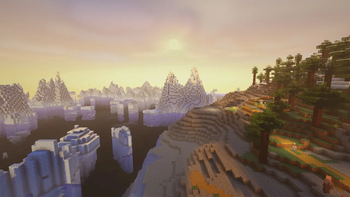
Sunrise
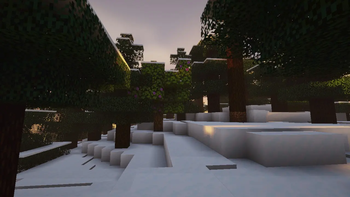
Forest at sunrise
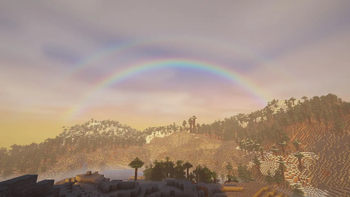
Rainbow
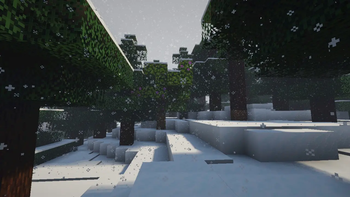
Snow in forest
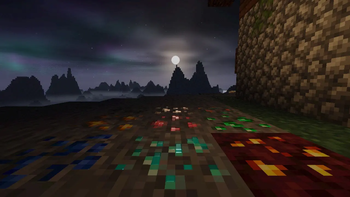
PBR
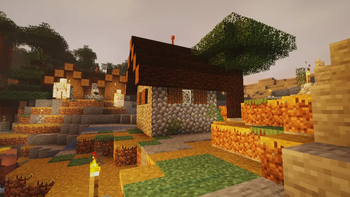
Village at sunrise
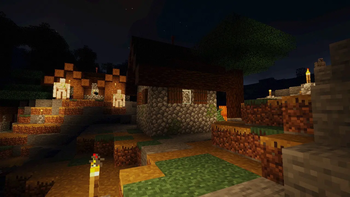
Village at night





Історія
Версії проєкту
Опубліковані версії та оригінальні файли Modrinth.
v1.1.4ОстанняRelease
21.08.2026 · 1 266 завантаження
IrisOptifine1.161.16.11.16.21.16.31.16.41.16.51.171.17.1
🚀 What's New in v1.1.4 — Atmosphere LUTs, Distant Horizons Seam Fix & Half-Res Bloom
Version 1.1.4 rebuilds the experimental physical sky around shared low-frequency LUTs, replaces the hole-producing DH screen-door seam with a deterministic hand-off, and cuts post-process cost with skippable half-resolution bloom. It also finishes the TAA story for Distant Horizons (correct DH reprojection + Halton jitter on LOD geometry) and swaps glittery water fBm for a coherent Gerstner swell.
🧪 Shared Physical-Atmosphere LUTs (begin / begin1)
- Tiny HDR LUTs, not fullscreen buffers. v1.1.3 deleted unused full-screen
colortex5/colortex6to save VRAM. v1.1.4 brings them back as 64×32 solar-transmittance (colortex5) and 32×16 multi-scatter / ground-bounce (colortex6) tables — kilobytes, not megabytes. begin.fshrebuilds direct solar transmittance every frame: sun elevation on X (−0.16…1.0, including civil twilight), camera altitude on Y (0–30 km), Kasten–Young airmass × Rayleigh + aerosol extinction, zeroed below the night hemisphere.begin1.fshlayers bounded multi-scattering and biome-aware ground bounce on top of that transmittance. Noon is Rayleigh-blue; low sun is warm; swamp/snow/vegetation tints come fromGROUND_BOUNCE_MODE.- Shared by every physical-sky consumer —
gbuffers_skybasic, terrain fog, water analytic reflection, volumetric godrays, clouds and the SSR sky fallback all sample the same LUTs instead of each running a second atmosphere march. - When
SKY_MODE=0(every shipped profile) the LUT passes write constants and cost almost nothing. Enable Physical Sky manually in the Experimental tab.
New Experimental → Atmosphere options (off-profile defaults stay cinematic / auto):
ATMOSPHERE_TURBIDITY— Crisp / Balanced / Hazy aerosol load.ATMOSPHERE_SCALE— Compact 25 m / Balanced 50 m / Cinematic 100 m per block (how Minecraft Y maps into atmosphere kilometres).GROUND_BOUNCE_MODE— Auto (biome-aware) / Neutral Soil / Vegetation / Snow / Desert.SKY_TEMPORAL— rotation-only history blend for the sky (requires TAA). Physical sky uses a higher history weight than the animated gradient sky so stars/aurora do not trail.
The swamp detector now also matches BIOME_MANGROVE_SWAMP.
🌍 Distant Horizons — Hard Seam, TAA & Iris Workaround
⚠️ AuraLite still does NOT claim full Distant Horizons compatibility. v1.1.4 is a targeted correctness pass on the v1.1.2/v1.1.3 experimental path.
- Hard deterministic hand-off at
far. The v1.1.3 16 m screen-door dither discarded random LOD fragments in the seam band; on DH 3.2 those holes showed sky/white whenever vanilla geometry did not fill the same pixel. DH fragments withdist < farare now simply discarded — less cinematic, never stochastic. - DH receives the same optional Halton camera jitter as vanilla gbuffers.
composite1.fshreprojects DH pixels throughdhProjectionInverse+dhPreviousProjection(vanilla matrices have the wrong far plane). - Conservative DH history cap (0.45) — LOD meshes change topology as chunks stream; they participate in TAA but cannot leave long trails.
DH_BLOCK_ILLUMINATEDtagcolortex2.a = 0.24— distant sea lanterns / glowstone stay self-emissive even when they are not lava-orange or portal-violet. Extra DH material classes: DIRT, SAND, TERRACOTTA.dh_waternow honoursWATER_WAVES/ riffles / transparency / specular, applies the frozen-ocean navy floor, and occludes againstdhDepthTex1(plus Irisdepthtex1via view-space Z, because raw depths use different projections).DH_SHADOW_RANGE— Seam (1.25×) / Extended (2×) / Far (4×) of vanillafar. LOD receivers can keep sampling the shared shadow map past the vanilla chunk edge.- Shadow-map footprint rebalanced for DH: MED 192 m, HIGH/ULTRA 512 m, EXTREME 768 m (VERY_LOW/LOW stay 60 m, no shadows).
dhShadow.enabled=falseby default. DH 3.2.0-b + Iris 1.7.6 can replace/cull the vanilla terrain shadow pass — symptom: mob shadows remain, block shadows vanish even in vanilla chunks. Users with a verified working Iris/DH bridge can turn the DH shadow pass back on and then useDH_SHADOW_RANGE.
🎯 TAA — Sky Temporal Resolve & Material Reactive Mask
- Sky temporal resolve (
SKY_TEMPORAL) — sky pixels have no stable world position, so history is reprojected with camera rotation only (no translation). Gradient-sky history weight is lower (0.28) than Physical (0.46) so clouds/aurora/meteors do not smear. - Material reactive mask — water (
0.8), foliage (0.62) and emissive/lava (< 0.5) cut history weight by 46% / 30% / 58%. Without a per-object velocity buffer this is what stops waving leaves and water from ghosting after TAA.
🌊 Gerstner Water Spectrum
- Replaces the v1.1.3 value-noise / fBm central-difference normal in
final.fsh. That field was mathematically stable but read as high-frequency random glitter. - A 4-direction travelling swell (dominant wind + cross swell + two low-amplitude ripples) produces analytic slopes and a calmer default surface. Amplitude is clamped to
±0.22. - Near-water vertex swell is slightly reduced (
0.04/0.02 → 0.032/0.016) so the geometric mesh matches the new reflection spectrum. - Dead Voronoi lava-height helpers removed from
gbuffers_water,gbuffers_terrain_translucentandgbuffers_terrain(lava stays texture-driven).
✨ Half-Resolution, Skippable HDR Bloom
- New master
BLOOMtoggle. VERY_LOW / LOW skip the entire 5-pass chain viaprogram.composite3–7.enabled=BLOOM(Iris/OptiFine do not even dispatch the programs). colortex3/colortex4are half-resolution (size.buffer = 0.5 0.5). Gaussian strides are doubled so the world-space radius stays the same;final.fshlinearly upsamples the glow.TAAsimilarly gatescomposite1/composite2, so lighter profiles no longer pay for unused fullscreen passes.
🌌 Aurora Quality
- New
AURORA_QUALITY— Soft 8 / Balanced 12 / Silky 18 raymarch steps, with a centred globally-animated ray start (the previous per-pixel hash grain is gone).
🎚️ Profile Rebalance (v1.1.4)
| Profile | Shadows | DH receivers | TAA | Bloom | Sky temporal |
|---|---|---|---|---|---|
| VERY_LOW / LOW | ❌ 512 / 60 m | Seam | ❌ | ❌ | ❌ |
| MED | ✅ 1024 / 192 m Balanced | Seam | ❌ | ✅ Balanced | ❌ |
| HIGH | ✅ 2048 / 512 m Balanced | Extended | ✅ | ✅ Balanced | ✅ |
| ULTRA | ✅ 4096 / 512 m Aggressive | Extended | ✅ | ✅ Balanced | ✅ |
| EXTREME | ✅ 8192 / 768 m Aggressive | Far | ✅ | ✅ Strong | ✅ |
Camera jitter remains off by default in every profile.
v1.1.3Release
07.08.2026 · 1 661 завантаження
IrisOptifine1.16.51.171.17.11.181.18.11.18.21.191.19.1
🚀 What's New in v1.1.3 — True TAA, HDR Bloom Pyramid & Black-Water Regression Fix
Version 1.1.3 completes the TAA pipeline (Halton sub-pixel camera jitter + YCoCg variance clipping), replaces the old single-pass bloom with a true multi-octave HDR gaussian pyramid, and fixes the long-standing black-water regression with MRT-proof water detection. It also adds procedural raindrop rings, biome-aware murky swamp water, underwater plant sway, post-TAA sharpening, and a ~48 MB VRAM cleanup.
🎯 True Temporal Anti-Aliasing (Halton Jitter + YCoCg Clipping)
- Halton(2,3) sub-pixel camera jitter — every gbuffer vertex shader can offset
gl_Positionby a rotating 8-frame Halton pattern (±0.5 px). Previously TAA only blended history without jittering the sample point, so it could only blur noise instead of reconstructing sub-pixel detail. TAA_JITTERoption — Off / Subtle / Standard / Strong (new in v1.1.3). The jitter is OFF by default in all profiles for a rock-steady image; Subtle (±0.25 px), Standard (±0.5 px) and Strong (±0.75 px) scale the amplitude for users who want the full sub-pixel reconstruction (removes high-frequency shimmer at the cost of a slight temporal wobble). Requires TAA enabled.- Previous-frame jitter compensation in
composite1.fsh— the old frame's offset is re-added to the reprojection (with the same strength scale), so static images converge instead of smearing ~0.5 px. Only active while jitter is on. - YCoCg variance clipping (μ ± γσ) replaces the axis-aligned 3×3 min/max box — the old box caused ghost trails on saturated high-contrast edges (fences, wires, hot specular) while being too tight on flat gradients. Clip width scales with
TAA_STRENGTH: 1.50 Light / 1.25 Balanced / 1.10 Stable. - Frame-rotated IGN dithers now resolve cleanly — godrays and volumetric clouds rotate their interleaved-gradient-noise patterns per frame; with the temporal resolve they integrate into smooth gradients instead of shimmering.
- TAA is on by default in HIGH / ULTRA / EXTREME profiles (off on VERY_LOW / LOW / MED for maximum FPS); it can be toggled in the Post-Processing menu, and
TAA_STRENGTHpresets the variance-clip tightness.
✨ HDR Gaussian-Pyramid Bloom (composite3 – composite7)
- Replaces the v1.0.1 single-pass 3×3 neighbour glow, whose ~1.5 px radius could only produce a tight halo.
- New 5-pass chain: threshold brightpass (0.75 luma soft-knee, exposure-aware) → tight separable gaussian (9-tap, σ≈2.0) → wide separable gaussian (4× stride). Successive blurs compose to an effective σ ≈ 8.2 px — a soft cinematic falloff around the sun/moon disks, lava, portals and hot specular, without a mip chain.
- Runs after the TAA resolve, so the bloom energy is temporally stable.
- New
HDR_BLOOMoption (Subtle 0.06 / Balanced 0.12 / Strong 0.22 amplitude) wired into every quality profile.
💧 Black-Water Regression Fix — MRT-Proof Water Detection
- Root cause: on some Iris builds the translucent pass drops the
colortex1/colortex2MRT writes entirely — water then arrives with a zeroed normal + alpha + lightmap. The emissive fast-path (alpha < 0.5) swallowed it and every tag/lightmap-based system died with it. - Detection ladder: primary =
colortex2.a = 0.8tag; rescue = the depth difference (depthtex1solid-only vsdepthtex0) proves a translucent surface on top, then a hue-fingerprint classifier on the albedo rejects portals (violet, green-starved) and lava (blue-starved) while accepting water (blue/blue-green, never pale). Water, ice and glass classify; torch flames, portal sparkles, squid ink, pale ice and clear glass do not. - Synthesized flat water normal when the decoded normal is untrustworthy (MRT loss or clear value), so Fresnel/reflections still have sane inputs.
- Analytic sky reflection (
waterSkyRefl) — zenith/horizon gradient + warm sun-side glow, dimension-aware (Overworld palette, Nether biome sheen, End violet sheen), applied via Schlick Fresnel with a 0.20 floor (pure F0≈0.02 at steep look-down angles was exactly what let shadowed water crush to black), multiplied by skyLight so cave water stays dark. This is the actual black-water fix and works with SSR disabled. - Diffuse ambient floor for rescued pixels whose lightmap may read zero.
- Navy-tint floor in
gbuffers_water/gbuffers_terrain_translucent— frozen-ocean biome tints (e.g. 0x3938C9) can no longer crush R/G to black after the gamma pipeline. WATER_DEBUGdiagnostics overlay (Off / Classify / Lightmap / Raw tag alpha) — green = healthy tag, red = depth-rescued, yellow = rescued from the emissive path, magenta = lava/portal-guarded.
🪟 SSR & Refraction Fixes (final.fsh)
- Procedural sky fallback for reflection rays that leave the screen or hit the sky — previously black (the reason the
waterMirrorBoosthack existed); now a day/night/sunset/storm-aware gradient with moon-phase brightness, Schlick-Fresnel weighting and edge fade. - SSR march start moved 1.0 → 0.5 view units off the surface so the water plane at the player's feet still reflects near-field geometry.
- MRT-proof water detection reused for SSR/refraction (same hue guards as
composite.fsh). - Procedural raindrop rings on wet up-facing surfaces — two layers of expanding, world-stable circular waves perturb the SSR normal so rain reads as thousands of tiny ripples instead of one flat mirror.
🔍 Post-TAA Sharpening (POST_SHARPEN)
- Gentle 5-tap unsharp mask (0.18 amplitude, clamped ≥ 0) applied to the resolved image before refraction/SSR/bloom work, recovering texture detail softened by TAA's history blending. On in MED+ profiles.
☁️ Volumetric Clouds — Quality Scaling & Dithered Ray Start
- New
CLOUD_QUALITYoption: 8 / 12 / 16 raymarch steps (was hardcoded 12) — Cheap / Standard / High. - Dithered ray start (frame-rotated IGN) on geometry pixels when TAA is enabled: the frame-rotating pattern is temporally resolved into a smooth volumetric integral, killing the 12-step ribbing on thick cumulus without the v0.2.5-era "swimming". Sky pixels keep the stable centred start.
🌿 Underwater Plants Sway
- New block class 10010 (
seagrass,tall_seagrass,kelp,kelp_plant,sea_pickle) — fronds sway in a current, phase-shifted by height so the tips lag the base, storm-agitated along with the surface foliage path. Displacement is mirrored inshadow.vshso shadows follow the visible fronds.
🌊 Biome-Aware Murky Water
- Smoothed swamp/mangrove detector (
isSwampBiome) — swamp water absorbs more red and reads greener and murkier (absorption (0.23, 0.038, 0.10), deep colour pushed to dark green) instead of open-ocean blue.
🧪 Physical Sky — Warm Ground Bounce
- The experimental
SKY_MODE=1atmosphere now includes a warm ground-bounce term: terrain's ~15–20% mean albedo re-scatters in the lower atmosphere (strongest at the horizon and with a high sun), removing the "sterile" blue-bias horizon band.
🌇 Lighting & Ambience
- Rayleigh-tinted day ambient — the day hemisphere ambient now follows the actual sun extinction: golden-hour light is warm and blue-depleted instead of static grey-blue.
- Held-light temperature — strong held sources (sea lantern, glowstone, shroomlight, lava bucket) read slightly cooler than candle-strength light.
🌍 Distant Horizons — Soft Seam
- The v1.1.2 hard
discardatfar + 16is replaced by a screen-door dithered transition band: DH LOD fragments stochastically blend into vanilla chunks over 16 m, so crossing the boundary or changing render distance no longer shows a hard cut. The pattern is static per frame (DH-only pixels are excluded from TAA history).
🛠️ Pipeline & VRAM Cleanup
- Removed
colortex5/colortex6format directives — never read or written, but each forced Iris/OptiFine to allocate a full RGBA16F screen buffer: ~32 MB saved @1080p, ~128 MB @4K. shadowcolor0FormatRGBA16F → RGBA8 (it only carries LDRtex * glcolor): another ~16 MB @1080p / ~64 MB @4K.shadowcolor1Formatremoved (nothing ever wrote to it).colortex0Clear = true— no stale garbage on the first frame or after a window resize.colortex3/colortex4are now actually used by the bloom pyramid; the full 8-buffer HDR pipeline is engaged.
v1.1.2Release
24.07.2026 · 1 507 завантаження
IrisOptifine1.161.16.11.16.21.16.31.16.41.16.51.171.17.1
🚀 What's New in v1.1.2 — Render-Distance Shadows & Experimental Distant Horizons (Partial)
Version 1.1.2 extends shadow rendering to the actual render distance with an adaptive LOD system, fixes HDR/TAA pipeline strictness, cleans up deprecated GLSL, and introduces partial, experimental Distant Horizons support (WIP) — without claiming full compatibility yet. Work is ongoing.
🌗 Extended Shadow Distance with Adaptive LOD
- Shadows now reach render distance.
shadowDistancewas60-160mwith a hard cutoff atshadowDistance. Now it scales with quality profiles: 60m (VERY_LOW/LOW, no shadows) → 120m (MED) → 256m (HIGH/ULTRA) → 384m (EXTREME). The cutoff is replaced by a soft fadesmoothstep(far*0.85, far*0.98). - New
SHADOW_LODtoggle — Off / Balanced / Aggressive. Reduces sample count and expands filter radius at distance to keep performance stable: - Balanced:
>25% far → 16 samples ×1.8 radius, >50% → 8 ×2.8 - Aggressive:
>15% → 16×2.0, >35% → 8×3.5, >60% → 4×5.0 - Beyond 95%
farshadow sampling is skipped entirely. shadowMapResolutionnow includes8192. EXTREME uses 8192 for maximum texel density at 384m. HIGH stays 2048, ULTRA 4096.- New
SHADOW_PCSS_BLURtoggle — fixed softness vs PCSS penumbra softening. When enabled, penumbra grows with blocker distance and rain. When disabled, shadows use constant softness. - PCSS correctness fixes in
composite.fsh:sampleShadow(): added UV bounds checks (prevents clamp-to-border artifacts),avgBlockerDepthclamped to1e-4to avoid NaN,penumbraSizeclamped0-2.0,lightSizereduced140→40to prevent light bleeding,actualSpreadcapped to16.0, out-of-bounds samples counted as unshadowed (1.0) for correct averaging. - Shadow bias
distBiasnow scales withfarinstead ofshadowDistance, plus extra water receiver bias for tagged water pixels (colortex2.a≈0.8).
🔧 HDR Pipeline Strictness Fix
- Dummy
#define RGBA16F 0guards added before theconst int colortex*Format = RGBA16Fdirectives. This satisfies strict GLSL validators (C1503 undefined variable RGBA16F) while Iris/OptiFine's parser still reads the format names (spec second clause). In v1.1.1 the directives were inside a/* */comment and were ignored by some loaders. - Now all used buffers are explicitly
RGBA16F:colortex0/1/2(main HDR + PBR + material tags),colortex3/4/5/6(unused today but set to HDR for a full pipeline),colortex7(TAA history,colortex7Clear=false), and optionalshadowcolor0/1Format = RGBA16F. - Cost noted: ~16MB per 1080p RGBA16F buffer → ~128MB VRAM for 8 buffers.
🌍 Experimental — Partial Distant Horizons Support (WIP, not full support)
⚠️ AuraLite does NOT yet claim full Distant Horizons compatibility. v1.1.2 only adds a minimal, experimental code path so LOD chunks are no longer invisible under Iris. It's functional enough for testing, but considered partial and work-in-progress.
- Why it was needed: Without
dh_terrain.vsh/.fsh,dh_water.vsh/.fsh,dh_shadow.vsh/.fsh, Iris marks the pack as incompatible with DH and simply doesn't draw DH's simplified LOD chunks at all — symptom "shader works but DH chunks invisible". Presence of these files is enough for Iris/DH auto-detection (dhShadow.enableddefaults true). - What v1.1.2 does:
dh_terrain/dh_waterwrite the samecolortex0/1/2layout as vanilla passes, so existing lighting/fog/shadow/cloud/godray code incomposite.fshapplies to LOD geometry without other changes.- Depth reconciliation in
composite.fsh: detectsdepthtex0>=1.0 && dhDepthTex0<1.0→isDHTerrain, reconstructs viewPos viadhProjectionInverse(notgbufferProjectionInverse— different far planes) and computesisSkyPixel. Fixes DH terrain being treated as sky (flat/washed-out). - Fog rescale:
effectiveDensity *= far/dhRenderDistanceprevents exponential fog from saturating to white before DH draw distance. - Emissive fast-path uses
!isSkyPixelinstead ofdepth<1.0so distantDH_BLOCK_ILLUMINATED(glowstone/lanterns) is still emissive. final.fshheat shimmer now checksdhDepthTex0viaisRealGeometryso distant lava lakes also shimmer.- Overdraw prevention:
if(dist < far+16.0) discardin DH passes — DH renders entire world including area already covered by vanilla chunks; without discard both fight over same G-buffer pixel causing Z-fighting / missing water/ice. - Current limitations (why it's partial):
gl_MultiTexCoord2is not guaranteed to carry valid lightmap data for DH programs — v1.1.2 hardcodeslmcoord = vec2(0.0,1.0)(open sky, no torch). Correct for exterior DH, but not interior-perfect.- No LabPBR
normals/specularmaps for DH — roughness/metalness approximated perdhMaterialId(STONE/WOOD/METAL/SNOW/LEAVES/LAVA...). No POM on DH. - Water uses flat vertex normal, not procedurally displaced like near water.
- Fog/sky/cloud code paths are shared but DH has coarser geometry.
- Ongoing work: proper skylight baking if DH ever exposes it, LabPBR fallback, smoother transition seam, performance tuning. Full support will be announced separately.
🛠️ Pipeline Cleanup & Fixes
- Menu split fix —
[v1.1.1-ui-hotfix]: Oversized option screens were split into[SHADOW_OPTIONS],[PBR_OPTIONS],[AO_REFLECTIONS],[CLOUD_SHAPE],[LIGHT_SHAFTS],[NIGHT_SKY]because some Iris/OptiFine UI builds silently hide buttons when a screen has too many entries. - Deprecated
ftransform()removed fromcomposite.vsh,final.vsh,gbuffers_clouds.vsh,composite1.vsh,composite2.vsh,gbuffers_weather.vsh— replaced with explicitgl_ProjectionMatrix * gl_ModelViewMatrix * gl_Vertexfor broader driver compat (same fix applied toshadow.vshin v1.1.0). - Final pass cleanup: Removed two duplicate copy-pasted post-gamma dither blocks that contradicted the comment about linear-space dither (triangle
±1/255before tonemap). The single pre-tonemap dither remains — more effective in darks, silent in brights. - Bias & stale comment fixes: Corrected stale
colortex6hand-off comment (removed in v1.0.3), now notes thatfinal.fshreads normal fromcolortex2and roughness fromcolortex1.z. - Rebalanced profiles to reflect new distances and LOD:
- VERY_LOW/LOW 60m (no shadows), MED 120m Balanced, HIGH 256m Balanced, ULTRA 256m Aggressive, EXTREME 384m Aggressive + 8192 res.
- Localization: Bumped
lang/*.langheadersv1.0.7 → v1.1.2, translated previously-Englishprofile.*.commentplaceholders into native languages (ur_pk, vi_vn, zh_cn, zh_hk, zh_tw and others).
v1.1.1Release
10.07.2026 · 1 349 завантаження
IrisOptifine1.16.51.171.17.11.181.18.11.18.21.191.19.1
🛠️ What's New in v1.1.1 — Pipeline Correctness Fix
Version 1.1.1 is a focused bug-fix release for the v1.1.0 codebase. It keeps the visual design intact while fixing configuration and runtime issues found in the shader pipeline:
- Moved HDR/TAA buffer directives to GLSL const directives so
colortex0/1/2/7formats and persistent TAA history are actually applied by Iris/OptiFine. - Replaced the custom
SHADOW_RES/SHADOW_DISTANCEmenu controls with realshadowMapResolutionandshadowDistancepipeline constants. - Fixed Nether/End dimension fallback detection so a default
dimension=0cannot override biome/fog-based Nether/End detection. - Retuned shadow bias to a balanced value with extra water receiver bias: fixes low-sun Peter Panning while cleaning remaining Shadow Acne on water/ice surfaces.
- Made underwater caustics and ground-mist sheets world-stable by using
cameraPosition-corrected world coordinates. - Added performance-neutral height-aware pseudo-3D cloud noise: same ray steps/noise calls, but cloud density now changes through Y instead of looking like flat 2D sheets.
- Added
WET_REFLECTIONSto the menu and wired it into final-pass SSR wetness. - Added profile-scaled
SKY_QUALITY, removed physical-sky hash-noise by switching to centred higher-sample raymarching, fixedSKY_STYLEgrading so it affects only the base sky, restored readable sun/moon sizes in gradient sky, and corrected moonbow direction. - Fixed emissive-surface cloud lighting, added a safe fallback for unknown tagged translucent blocks, removed the empty translation submenu, made TAA default-off as a standard user toggle, and synced waving vegetation displacement in the shadow pass.
- Forced vanilla Minecraft clouds off via
clouds=falseand addedgbuffers_cloudsdiscard shaders as a fallback, so AuraLite's procedural clouds do not overlap with default clouds. - Added
gbuffers_weatherto make vanilla rain/snow streaks less dense and more transparent by default. - Added explicit opaque entity/hand passes to prevent players, mobs and held items from appearing semi-transparent.
v1.1.0Release
03.07.2026 · 692 завантаження
IrisOptifine1.16.51.171.17.11.181.18.11.18.21.191.19.1
🆕 What's New in v1.1.0 — True Volumetric Godrays, HDR Pipeline & Experimental Physical Sky
Version 1.1.0 replaces the screen-space godray approximation with a fully volumetric raymarched implementation, switches the entire G-buffer pipeline to true HDR (RGBA16F), and introduces an experimental, fully physical realtime atmospheric-scattering sky mode as an opt-in alternative to the stable gradient sky. This is a focused two-pillar update on top of the v1.0.7 bug-fix baseline.
🌤️ True Volumetric Godrays
The old computeGodrays() screen-space approximation has been replaced by computeVolumetricGodrays() — a genuine single-scattering volumetric raymarch:
- Per-step shadow-map occlusion — every raymarch sample now tests the shadow map individually, so light shafts are actually carved by real geometry (trees, buildings, cave ceilings) instead of being implied by a "forward-looking boost" toward the sun.
- Interleaved Gradient Noise dithering (Jimenez 2014), rotated per-frame via the new
frameCounteruniform when TAA is active — 8–24 raymarch steps now integrate as smoothly as hundreds, with no banding. - Exact per-segment Beer–Lambert integration —
Tr₀ · σs/σt · (1 − e^(−σt·Δx))per step, which is energy-conserving regardless of step size (no more over-brightening at low sample counts). - Dual-lobe Henyey-Greenstein phase function (forward + weak backscatter lobe) with an isotropic floor, so crepuscular rays stay visible when looking across them, not only when staring directly at the sun.
- Colored radiance — shafts are now warm Kelvin-driven sunbeams by day, deep orange at sunset, and faint blue moonbeams at night, instead of a flat white/yellow overlay.
- New
GODRAYS_STRENGTHsetting (Subtle / Balanced / Dramatic) added to every quality profile. GODRAYS_QUALITYsample counts and distances increased: Fast 8 samples/96m, Balanced 16/128m, High 24/160m (up from 4/72m, 6/110m, 8/150m in v1.0.7).
🌈 Full HDR G-Buffer Pipeline
colortex0,colortex1, andcolortex2are now explicitlyRGBA16F. Bright sources — the sun disk, lava, specular highlights, portals — no longer clip to1.0before tone mapping, so the ACES/AgX curves infinal.fshfinally compress genuine HDR highlights instead of receiving pre-clamped input. Bloom now samples real HDR luminance rather than an already-saturated LDR buffer.colortex2's alpha channel carries a 5-value material tag (0.0/0.1/0.62/0.8/1.0); RGBA16F guarantees these are preserved exactly, whereas a lower-precision format would have aliased and collided material tags (e.g. foliage vs. water).- Godray intensity constants were re-tuned (roughly halved vs. the old LDR values) now that the additive shaft survives in full instead of clipping against a saturated scene; a stronger soft shoulder (
0.50vs. the old0.30) keeps the sun-facing core from blowing out under HDR.
🧪 Experimental: Realtime Physical Sky (Off by Default)
A brand-new [EXPERIMENTAL] menu tab exposes an alternate sky renderer in gbuffers_skybasic.fsh, disabled in every shipped profile (SKY_MODE=0) so the stable gradient sky remains the default:
SKY_MODE—0(Gradient, legacy v1.0.7-style sky) or1(Physical Realtime): a genuine per-pixel ray-marched atmosphere with exact 1st-order single scattering (Rayleigh + Mie + Ozone, full sun-ray optical-depth march with ground-occlusion detection) plus a blue-biased, bounded multiple-scattering ambient term that fills in the zenith/horizon without producing the typical LUT-based "yellow band" artifact. No lookup textures, no cross-frame reads.SKY_QUALITY— controls raymarch sample counts (Fast 8×4 / Standard 12×6 / High 16×8) for the physical mode.SKY_STYLE— new artistic-direction toggle independent ofSKY_MODE: Realistic (true angular sun/moon size, neutral colors, minimal glow — an authentic astronomy look), Semi-realistic (readable ×2.8 sun/moon size, richer color, soft aureole — the default), or Fantasy (grand ×5.5 sun/moon, huge corona, vivid saturated teal/crimson/indigo palette for a stylized sky).- Physical mode renders the sun disk with real limb darkening and a physically-derived angular radius, and computes its color from actual sun-ray transmittance (ozone-aware) rather than the legacy Kelvin/airmass approximation.
- Because this feature is explicitly experimental and disabled by default, it introduces no behavioral change to any existing profile.
🛠️ Smaller Fixes & Cleanup
- Dark-sky/moon-halo banding fixed at the source — a linear-space triangle-distributed dither (
±1/255, matching the BSL/Complementary technique) is now applied infinal.fshbefore tone mapping, where gamma expansion makes a tiny linear noise term large enough in the darks to smooth the gradient, while staying invisible in bright regions. The old post-gamma dither (which couldn't fix pre-tonemap banding) has been removed and replaced with an explicit finalclamp(). shadow.vshno longer relies on the deprecated fixed-functionftransform(); it now builds the clip-space position explicitly viagl_ModelViewMatrix/gl_ProjectionMatrixfor broader driver compatibility.- Updated localization strings for
GODRAYS,GODRAYS_QUALITY, and the newGODRAYS_STRENGTH/SKY_MODE/SKY_STYLE/SKY_QUALITYoptions and the new Experimental tab.
v1.0.7Release
26.06.2026 · 757 завантаження
IrisOptifine1.16.51.171.17.11.181.18.11.18.21.191.19.1
🆕 What's New in v1.0.7 — Comprehensive Bug Fix, Stability & Aurora Refinement Update
Version 1.0.7 conducts a deep code audit across the entire GLSL 460 pipeline to resolve rendering anomalies, feedback loops, and multi-pass inconsistencies introduced in earlier releases, and additionally refines the Aurora Borealis to remove high-frequency visual noise while softening its overall luminance.
🐞 Bug Fixes & Architectural Polish
- Massive Volumetric Cloud, Godray & Aurora FPS Bottleneck Resolved
- Underwater Screen-Space Ripple Distortion Feedback Loop Fixed — Removed legacy underwater ripple screen distortion from
composite.fsh(where it erroneously sampled raw unlit G-buffer albedocolortex0and mixed unshaded texels into the lit scene). Moved clean underwater screen-space view perturbation directly intofinal.fsh, sampling the fully lit, composited, and TAA-resolved scene. - Glass & Ice Water Refraction / Reflection Distortion Fixed — Solved a multi-target G-buffer collision where stained glass windows and ice blocks triggered the depth-comparison detector
(depthS - depth) > 1e-5infinal.fsh. Added a dedicated material alpha tagcolortex2.a = 0.8for water ingbuffers_waterandgbuffers_terrain_translucent, ensuring glass windows (1.0) and ice blocks (1.0) never receive underwater refraction ripples or wavy water SSR reflections. - Procedural Lava POM Coordinate Discard Fixed — Standardized the 4-step Parallax Occlusion Mapping loop in
gbuffers_water.fshandgbuffers_terrain_translucent.fshto matchgbuffers_terrain.fsh. Displaced UV coordinatesp = currentTexCoordsare now properly retained across the entire shader block for crack height calculations, temperature gradients, hotspots, and rising bubbles. - Unnormalized Lava Normal Output Fixed — Normalized the G-buffer normal output
normalize(normal)ingbuffers_terrain.fshbefore encoding intocolortex2, preventing interpolated vector length drift across triangle interiors. - Camera-Inside Volumetric Fog, Ground Mist & Valley Sheets Fixed — In
getInsideGroundMistVeil(),applyInsideCloudVeil(), and distant ground mist sheet rendering, fixed the exponential absorption rate (lowered from0.014/0.0105to0.0018/0.0035) and removed hardcoded blanket opacity ceilings (0.30/0.34). Wired the user'sFOG_DENSITY_LEVELsetting directly into volume optical thickness. Added a smooth attenuation factor(1.0 - camMistHere * 0.95)to distant 2D sheets when standing inside the ground mist layer, preventing double-accumulation with the screen-space volumetric veil. - PCSS Blocker Search Self-Shadow Acne Fixed — Updated the blocker depth comparison threshold in
composite.fshfrom a static1e-4epsilon to the dynamic surface slope bias (bias). Sloped terrain no longer detects itself as a false shadow occluder. - POM Division-By-Zero NaN Fixed — In
getParallaxCoords(), changed the ray hit weight denominator from(afterDepth - beforeDepth + 0.0001)tomin(afterDepth - beforeDepth, -1e-5). SinceafterDepth - beforeDepthis strictly negative, adding+0.0001mathematically cancelled out the denominator to zero on subtle step transitions, causing black dot NaN artifacts. - POM Optical View Angle Cotangent Scaling & Limiting Added — Scaled tangent-space UV step offsets by
V_tang.xy / max(abs(V_tang.z), 0.15)across all POM passes. Parallax crack depth now physically stretches when viewed at grazing angles instead of flattening out. - Procedural Lava Sub-Step POM Linear Interpolation Added — Replaced the discrete sub-step endpoint
p = currentTexCoordsin the lava POM loop with exact linear interpolationmix(currentTexCoords, prevTexCoords, weight). Internal crack walls no longer suffer from 4-step banding/stepping artifacts. - Block Mapping Extended — Added
minecraft:magma_blockto block ID10009inblock.properties, granting overworld and nether magma blocks dynamic procedural glowing Voronoi cracks.
🌌 Aurora Borealis Refinement — Smoother & Softer
The volumetric Aurora in gbuffers_skybasic.fsh was producing subtle high-frequency "static" patterns and reading slightly oversaturated on bright presets. The shader pass has been retuned in this release:
- Dither offset re-centered and weakened — Replaced the
0..1per-pixel ray start offset with a centered-0.5..+0.5range scaled down to0.6 × dt. Adjacent pixels now sample closer ray distances, eliminating the flickering pattern that read as visual noise. - Vertical ray frequency lowered (32.0 → 14.0) — The single very-high-frequency
sin(uv.x × 32)that powered the striations aliased into thin static-like lines. Two slightly offset waves (14.0+9.0) are now blended together withmix(0.5)to break the periodic aliasing while preserving the characteristic vertical pillar look. - Ray sharpness softened (3.0 → 1.8) and amplitude reduced (2.0 → 1.3) — Pillars no longer have harsh, sharp edges; they blend smoothly into the curtain ribbon.
- Curtain ribbon exponent softened (5.0 → 3.5) and weight lowered from
0.5to0.45— Lighter, more atmospheric curtains without the blocky stripe artifacts the high power was producing. - Spatial color variation slowed down —
sin(worldDir.x × 3.5 + worldDir.z × 2.8) × 0.2→sin(worldDir.x × 2.2 + worldDir.z × 1.7) × 0.18. Color shifts across the sky are now gradual instead of rapid. - Photographic palette toned down (~30% dimmer):
- Cyan-Green:
(0.0, 0.80, 0.50)→(0.0, 0.55, 0.32) - Magenta/Purple:
(0.60, 0.10, 0.70)→(0.42, 0.08, 0.50) - Deep Blue (upper edge):
(0.05, 0.10, 0.50)→(0.04, 0.08, 0.35) - Optical depth scaling lowered (0.35 → 0.26) and final intensity multiplier
× 0.78— Overall accumulation is roughly 35–40% softer than the v1.0.6 original. TheAURORA_STRENGTHprofile setting still controls user-level intensity on top.
The aurora now reads as a soft, glowing, photographic northern light rather than an over-saturated neon stripe pattern. No menu changes; no new options; no profile changes. All existing AURORA_MODE, AURORA_SPEED, and AURORA_STRENGTH settings behave as before.
v1.0.6Release
19.06.2026 · 802 завантаження
IrisOptifine1.16.51.171.17.11.181.18.11.18.21.191.19.1
🆕 What's New in v1.0.6 — Procedural Lava & Heat Shimmer
Version 1.0.6 adds a physically-inspired procedural lava block renderer and a subtle heat-shimmer post-processing effect. It is a focused visual update on top of v1.0.5.
🔥 Procedural Lava / Magma (Block ID 10009)
- Block mapping —
minecraft:lavaandminecraft:flowing_lavaare now tagged with block ID10009inblock.properties. - 3D Voronoi cracks — the surface is generated with a procedural Voronoi crack field (basalt crust on top, glowing magma in the cracks) using a 4-step parallax occlusion raymarch for real depth.
- Animated convection flow — slow noise-driven convection makes the magma crawl and pulse.
- Localized hot spots & bubbles — rare high-contrast yellow-orange hot spots and short-lived rising bubbles add life without turning the surface into noise.
- Viscous waves — only the top face receives a slower, heavier vertex displacement so lava feels thick and molten.
- PBR-ready — the basalt crust is rough (0.95) while the magma cracks are extremely glossy (0.02), giving physically plausible highlights.
- Multi-pass coverage — lava is handled in
gbuffers_terrain,gbuffers_water, andgbuffers_terrain_translucentso it renders correctly on both Iris and Oculus pipelines regardless of which pass the loader assigns fluid blocks to.
🌡️ Heat Shimmer Above Lava
final.fshdetects lava pixels through a dedicatedcolortex2alpha signature (0.1) and applies a subtle, slow screen-space distortion that simulates rising hot air.- The effect is constrained by depth and by the lava mask, so it only affects pixels directly above or next to lava surfaces.
- New in-game options:
HEAT_SHIMMER(on/off) andHEAT_SHIMMER_STRENGTH(Subtle / Balanced / Strong), located in the[Post-Processing & Fog]menu.
v1.0.5Release
13.06.2026 · 448 завантаження
IrisOptifine1.16.51.171.17.11.181.18.11.18.21.191.19.1
🆕 What's New in v1.0.5 — Expanded Localization
Version 1.0.5 is a localization-focused release that adds 10 new in-game languages, bringing the total to 69 supported locales. No shader logic, profile defaults, or rendering behavior was changed — this is a pure translation / metadata update on top of v1.0.4.
🌐 New Languages
The following fully-translated .lang files were added (every option name, value label, profile name and tooltip — 289 keys each, 100% key parity with the English source):
| Code | Language | Code | Language |
|---|---|---|---|
gl_es |
Galician | sw_ke |
Swahili |
ga_ie |
Irish | nn_no |
Norwegian Nynorsk |
gd_gb |
Scottish Gaelic | tt_ru |
Tatar |
af_za |
Afrikaans | hy_am |
Armenian |
az_az |
Azerbaijani | zh_hk |
Cantonese (Hong Kong) |
- As with all non-English locales, the in-game ⚠ Translations may contain errors notice applies — some strings in rarer languages may be imperfect; compare with the English original if anything looks off.
v1.0.4Release
07.06.2026 · 398 завантаження
IrisOptifine1.16.51.171.17.11.181.18.11.18.21.191.19.1
🆕 What's New in v1.0.4 — Profile Rebalance, Translucent Blocks & Glass Rendering
Version 1.0.4 delivers a full quality-profile rebalance for smoother progression, introduces proper translucent block rendering for ice and glass, adds a dedicated Iris/Oculus translucent terrain pass, and fixes a cross-vendor GLSL compatibility issue.
🔄 Full Profile Rebalance
All six quality profiles (VERY_LOW → EXTREME) have been rebalanced for a smoother, more logical feature progression:
| Profile | Key Changes in v1.0.4 |
|---|---|
| VERY_LOW | Sun intensity lowered to Dim (1), underwater night set to Moonlit Pool for visibility. |
| LOW | Ambient brightness lowered, cozy lights disabled, Filmic tone mapping (ACES), underwater night set to Dim. Stars upgraded to Standard. |
| MED | Godrays now enabled (Fast quality) — this was the biggest missing piece in the sweet-spot preset. PBR strength raised to Standard. Meteor frequency normalized. |
| HIGH | SSAO now enabled (Subtle) — contact shadows appear at this tier. Godrays bumped to Balanced. Moon intensity lowered to Standard. |
| ULTRA | Godrays raised to High. TAA strength at Balanced. |
| EXTREME | Water wave scale pushed to Stormy. Underwater night set to Pitch Dark for maximum survival realism. Photographic (AgX) tone mapping. |
🧊 Split Ice & Glass Block Rendering
- Regular ice (
minecraft:ice, block ID 10005) now renders with its actual texture and semi-transparency instead of being fully opaque. Transparency scales with theWATER_TRANSPARENCYsetting (Clear / Balanced / Deep). - Packed ice, blue ice, and frosted ice (block ID 10007) are now rendered opaque with texture — distinct from regular ice so the visual difference is clear.
- All glass blocks and panes (block ID 10008), including every stained-glass variant and tinted glass, now render with their actual texture and proper transparency. Glass opacity scales with
WATER_TRANSPARENCY. This eliminates the old "invisible glass" problem where glass blocks disappeared against bright skies. - Both ice types and glass are handled by the new
gbuffers_terrain_translucentpass, ensuring correct rendering on Iris/Oculus split-translucent pipelines.
🪟 New Translucent Terrain Pass (gbuffers_terrain_translucent)
- A new
gbuffers_terrain_translucent.fsh/.vshshader pair was added. This pass handles water, ice, glass, and nether-portal blocks in a single Iris/Oculus-compatible translucent terrain path. - Mirrors the existing
gbuffers_water.fshlogic so translucent blocks render identically regardless of whether the loader uses a unified or split translucent G-buffer path. - Nether portal plasma, ice Fresnel, glass opacity, and water Fresnel/ripples all route through this pass.
🛠️ GLSL Compatibility Fix
- Replaced all
fma()calls with direct multiply-add expressions across every shader file. Thefma()intrinsic, while correct on most modern GPUs, caused compilation failures on certain drivers (particularly older Intel iGPUs and some Mesa versions). The replacementa * b + cexpressions are mathematically equivalent and compile universally.
v1.0.3Release
06.06.2026 · 165 завантаження
IrisOptifine1.16.51.171.17.11.181.18.11.18.21.191.19.1
🆕 What's New in v1.0.3 — Anti-Aliasing & PBR Performance
Version 1.0.3 adds configurable spatial anti-aliasing (FXAA / SMAA) and a PBR render distance control that skips expensive Cook-Torrance specular calculations on distant terrain.
🖼️ Spatial Anti-Aliasing (FXAA / SMAA)
SPATIAL_AA_MODE— new toggle in the[Post-Processing]menu with 3 modes:- Off — no spatial AA (TAA-only or nothing).
- FXAA — Fast Approximate AA. Sobel gradient-directed edge detection with conservative blend weights. Cheap and effective.
- SMAA — Subpixel Morphological AA. Combines luminance Sobel gradient with depth discontinuity detection for superior edge detection on geometry where luma contrast is low. Slightly more expensive than FXAA.
- Both modes operate in linear space before tone mapping and are conservative enough to avoid washing out the image (max blend weight 0.15–0.18, high edge thresholds).
- Freely combinable with TAA (composite1 pass) for temporal + spatial smoothing.
- Added to all 6 quality profiles: VERY_LOW=Off, LOW/MED=FXAA, HIGH/ULTRA/EXTREME=SMAA.
⚡ PBR Render Distance
PBR_DISTANCE— new setting in the[Lighting Settings]menu with 4 levels:- Near (16m) — PBR specular only on very close surfaces. Maximum GPU savings.
- Standard (48m) — balanced distance. Default for LOW/MED profiles.
- Far (128m) — extended range. Default for HIGH/ULTRA profiles.
- Unlimited — no distance limit. EXTREME profile only.
- Beyond the fade range, the entire Cook-Torrance BRDF block (GGX distribution, Smith geometry, Fresnel-Schlick) is completely skipped via early-out — no wasted ALU on sub-pixel specular.
- Fade is smooth (
smoothstepbetween start and end distance) to avoid visible pop-in.
🌐 Localization
- Full English and Russian localization for both new settings (option names + value labels).
- Other language files fall back to English labels.
🌿 Foliage Subsurface Scattering (also finalized in v1.0.3)
FOLIAGE_SSS— toggle in the[Foliage Settings]menu. Enables light bleeding through leaves and plants when looking toward the sun, plus a soft wrap term for the shaded side. Controlled per-profile (enabled from MED upward by default). Uses material ID tagging ingbuffers_terrainand a dedicated SSS pass incomposite.fsh.- Added to all quality profiles (VERY_LOW → EXTREME) with the
!FOLIAGE_SSSorFOLIAGE_SSSflag. - Full English + Russian localization strings added.
v1.0.2Release
03.06.2026 · 243 завантаження
IrisOptifine1.16.51.171.17.11.181.18.11.18.21.191.19.1
🆕 What's New in v1.0.2 — Foliage Subsurface Scattering
Version 1.0.2 adds realistic subsurface scattering (SSS) for vegetation. Leaves, grass, and plants now look more translucent and alive when light shines through them.
🌿 Foliage Subsurface Scattering (FOLIAGE_SSS)
- New toggle in the
[Foliage Settings]menu. - Light bleeding from the back side of foliage + soft wrap term on the unlit side.
- Enabled from MED profile upward by default (disabled on VERY_LOW/LOW for maximum FPS).
- Integrated with existing PBR pipeline using material ID tagging (
matID10001–10004) ingbuffers_terrain. - Full English and Russian localization.
This is a focused, low-cost visual enhancement that makes forests and plants feel much more natural under direct sunlight.
v1.0.1Release
03.06.2026 · 58 завантаження
IrisOptifine1.16.51.171.17.11.181.18.11.18.21.191.19.1
🆕 What's New in v1.0.1 — Stability, HDR Bloom & Photographic Tone Mapping
Version 1.0.1 is a focused hotfix on top of v1.0.0 that addresses five edge-case rendering issues and introduces a new cinematic tone-mapping curve with lightweight HDR bloom.
🛠️ Bug Fixes
- TAA history acceptance threshold. Added
historySample.a < 0.99guard incomposite1.fshso uninitialised or stale history buffers (e.g. right after shader reload or resolution change) are rejected instead of causing ghosting. - Vibrancy math.
applyVibrancyinfinal.fshnow correctly handles negative saturation values — oversaturation works as intended rather than relying on undefined GLSLmixextrapolation followed by hard clamping. - SSR normal NaN guard. Added
length(N) > 0.5check beforetraceSSR()so invalid normals from edge pixels are silently skipped instead of producing black reflections. - SSR near-field trace precision. Minimum raymarch step lowered from
1.0to0.3view-space units, dramatically improving hit rate on close surfaces (ripples, shallow pools, wet stone). - Meteor moon-brightness curve.
gbuffers_skybasic.fshnow usescos²(phase × π/8)— identical togetMoonPhaseBrightness()incomposite.fsh— so moon washout is physically consistent.
🎨 Visual Enhancements
- HDR Bloom (v1.0.1). Cheap single-pass 3×3 neighbour blur for overbright pixels (luminance threshold 0.75). Naturally affects sun/moon disks, lava, portals, bright specular highlights, and torches — without smearing the entire scene or requiring extra render targets.
- Photographic (AgX-like) Tone Mapping (v1.0.1). A new
CONTRAST = 4option infinal.fshprovides a sigmoidal tone curve with natural highlight chromatic attenuation, soft toe, and lifted blacks — giving a cinematic, non-clipped look that keeps foliage saturation under control while handling extreme brightness gracefully. - EXTREME profile updated. Now uses
CONTRAST=4(Photographic/AgX-like) instead ofCONTRAST=3for cinematic highlight handling.
v1.0.0Release
02.06.2026 · 104 завантаження
IrisOptifine1.16.51.171.17.11.181.18.11.18.21.191.19.1
🆕 What's New in v1.0.0 — Meteor Showers & Finalized Reflection Pipeline
Version 1.0.0 builds on the volumetric aurora work from v0.3.0 and introduces the first v1.0.0 source snapshot in this repository. The update adds a physically-inspired meteor system to the night sky, finalizes the modern SSR path for reliable Iris compatibility, and refreshes the documentation so the project now correctly points to the shaders v1.0.0/ folder.
☄️ Physically-Based Meteors / Falling Stars
- True great-circle sky arcs. Meteors are rendered as moving arcs on the celestial sphere instead of flat 2D streaks, so showers converge toward a shared radiant like real meteor photography.
- Ablation-based brightness curve. Each meteor rises, peaks, and fades with a bell-shaped light curve inspired by atmospheric entry.
- Blackbody plasma colouring. Meteor heads are tinted with the same Kelvin-based colour pipeline used by AuraLite's sun/moon lighting, giving physically consistent warm-to-white fireball tones.
- Moonlight washout and weather attenuation. Faint meteors are suppressed by bright moon phases, rain, and daytime sky brightness, improving realism and avoiding visual clutter in poor visibility.
- Persistent trains on bright fireballs. The strongest events leave a short-lived glowing ionization trail, including a subtle green oxygen-style tint on the lingering train.
- Available in both Overworld and The End. Overworld meteors respect moonlight and atmosphere; End meteors render against the permanent night sky without moon washout.
🪞 Finalized v1.0.0 SSR / Water Reflection Path
colortex6fully removed from the reflection workflow. The older MRT export path was retired;final.fshnow reads normals directly fromcolortex2and roughness fromcolortex1, matching AuraLite's already-working PBR data path.- Depth-based water-surface detection. Water is identified by comparing
depthtex0anddepthtex1, making reflections robust on Iris paths where water G-buffer writes may be inconsistent. - More stable water normals. Reflection normals are reconstructed from neighbouring depth samples and then perturbed with coherent world-space ripple gradients, reducing faceting and torn reflections.
- Cleaner post-pass reliability. The reflection pipeline now lives entirely in the final post-processing pass, simplifying the frame graph and avoiding loader-specific MRT issues.
🎛️ New Sky Settings & Profile Integration
- New configurable options:
SHOOTING_STARS,SHOOTING_STARS_FREQUENCY, andSHOOTING_STARS_BRIGHTNESS. - Shooting stars are disabled on the lightest presets and enabled from MED upward through the normal profile system.
- English and Russian UI text was expanded for the new night-sky controls, while other language files continue to fall back safely.
v0.3.0-betaBeta
01.06.2026 · 105 завантаження
IrisOptifine1.16.51.171.17.11.181.18.11.18.21.191.19.1
v0.2.9-betaBeta
31.05.2026 · 113 завантаження
IrisOptifine1.16.51.171.17.11.181.18.11.18.21.191.19.1
v0.2.8-betaBeta
31.05.2026 · 60 завантаження
IrisOptifine1.16.51.171.17.11.181.18.11.18.21.191.19.1
v0.2.7-betaBeta
30.05.2026 · 95 завантаження
IrisOptifine1.16.51.171.17.11.181.18.11.18.21.191.19.1
v0.2.6-betaBeta
30.05.2026 · 51 завантаження
IrisOptifine1.16.51.20.11.21.126.1.2
v0.2.5-betaBeta
29.05.2026 · 71 завантаження
IrisOptifine1.20.1
v0.2.4-betaBeta
29.05.2026 · 22 завантаження
IrisOptifine1.20.1
v0.2.3-betaBeta
29.05.2026 · 29 завантаження
IrisOptifine1.20.1
v0.1.5-betaBeta
27.05.2026 · 32 завантаження
IrisOptifine1.20.1
v0.1.0-betaBeta
27.05.2026 · 28 завантаження
IrisOptifine1.20.1
Гортайте товари колесом або стрілками